Spider Mites on Indoor Herbs and Vegetables: What to Do When You Eat the Plant
Quick answer: To get rid of spider mites on indoor herbs and vegetables, start without sprays: move the plant away from others, rinse the undersides of the leaves with lukewarm water, and keep checking for a few weeks. Extension sources disagree on how often to rinse and on whether to spray plants you eat, so this guide shows both sides. If you consider a soap or oil, read the exact product label for your crop first.
Fine pale speckles on a basil leaf, or a hint of webbing under a pepper leaf: spider mites like the warm, dry conditions found in most homes. Most extension pages about them are written for houseplants, gardens or greenhouses, not for pots you cut dinner from.
This guide sticks to what university extension services say, and it tells you plainly where they disagree or say nothing about edible plants. The byline explains their advice. It is not a report of our own experiments.
In this guide: Are they spider mites? | Why they show up indoors | What to do first | Sprays and plants you eat | Keeping them out | FAQ
Are they really spider mites?
Spider mites are not insects. University of Maryland Extension describes mites as arachnids, the group that includes spiders and ticks, and notes that some spider mites are less than a millimeter long. University of Minnesota Extension puts the length at about 1/50 of an inch and describes two-spotted spider mites as yellow-orange with a dark spot on each side. Maryland says mite colors range from near-white or greenish-yellow to orange or red.
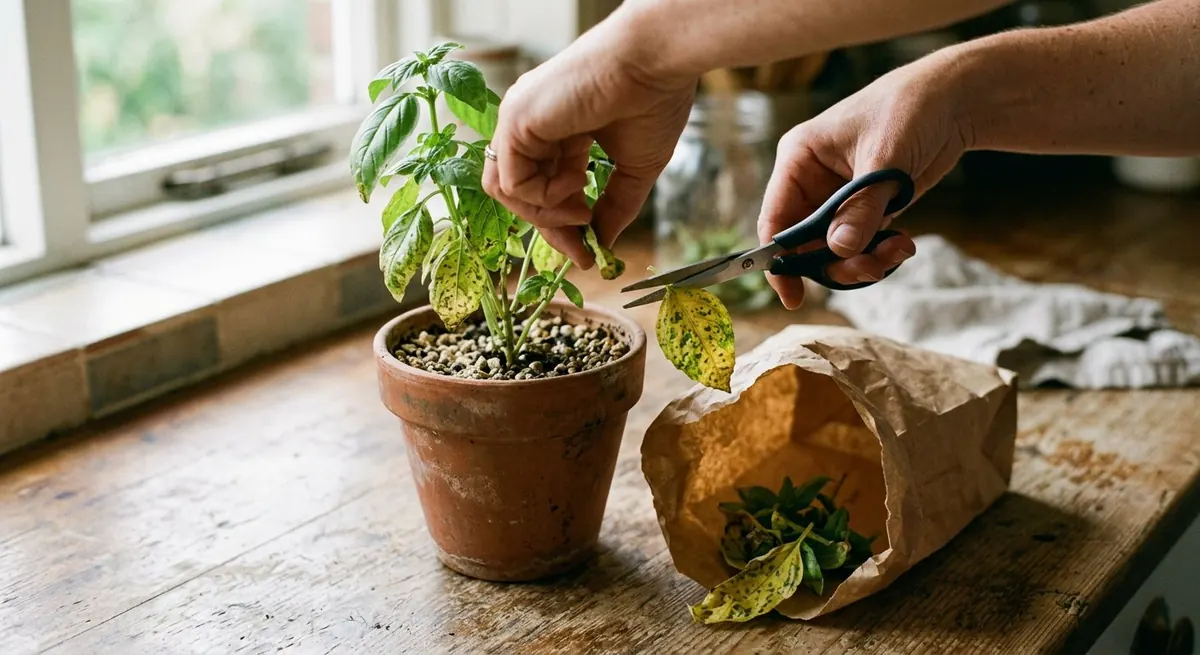
Because they are so small, you usually notice the damage first. Maryland describes pale flecking on the leaves, which it calls stippling. Iowa State Extension describes light infestations as foliage speckled with tiny tan spots, and heavy ones turning greenish-yellow and then tan or brown, with leaves dropping. Minnesota says heavy infestations also produce webbing.
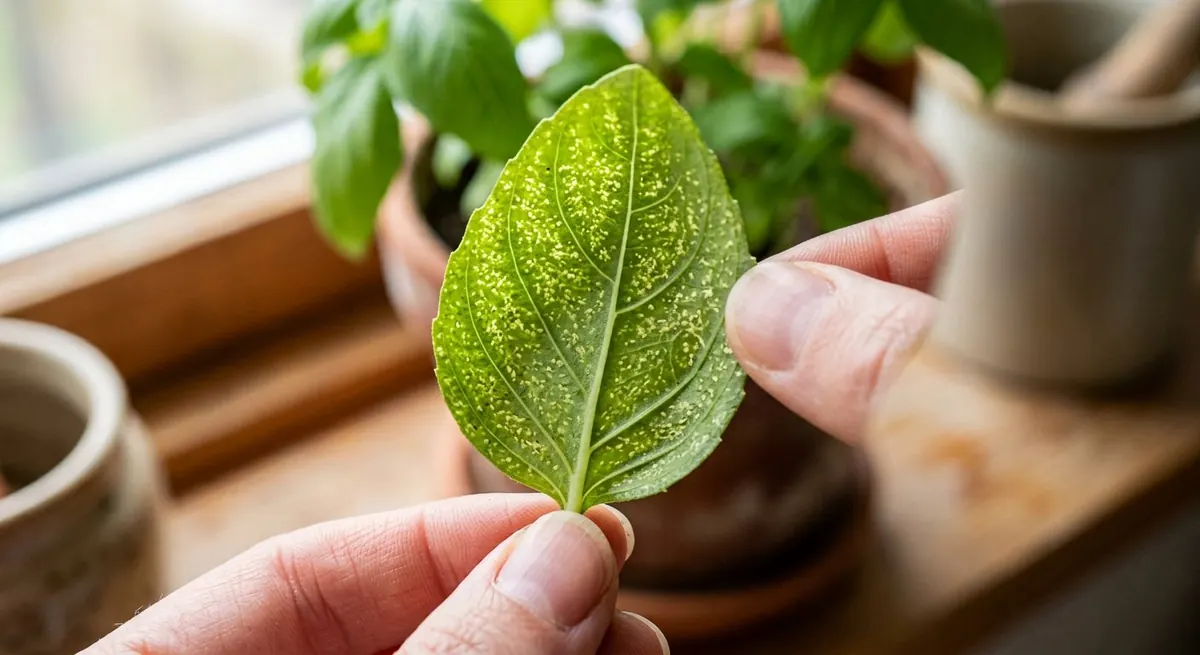
Two checks help. Look at the underside of a speckled leaf with a hand lens, as Minnesota and UC IPM suggest. Or hold a sheet of white paper under a stem and tap it. Iowa State says to look for small, slow-moving specks on the paper, and the University of Vermont Extension Master Gardener guide says they can look like pepper. UC IPM adds that you should confirm mites are present before you treat.
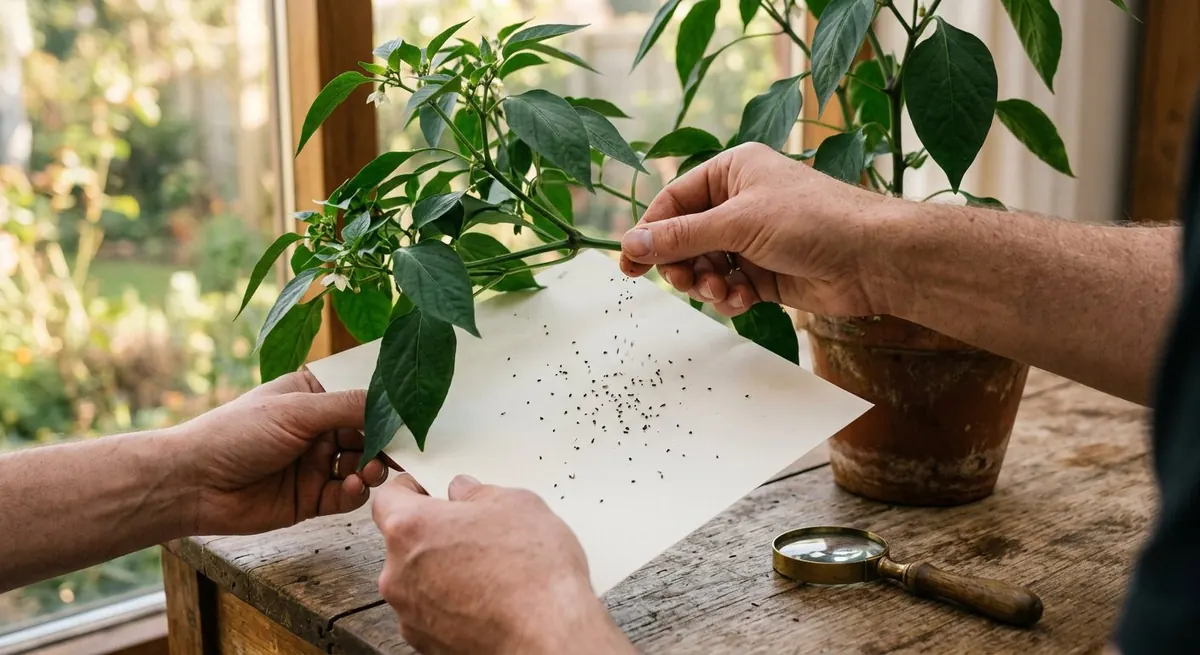
One catch: Minnesota says the symptoms can be confused with drought stress. If the paper test finds nothing, our guide to finding the cause by symptom can help you narrow it down. If the pests you see are tiny flies rather than specks, read about fungus gnats in herb and vegetable pots instead.
Why they show up indoors
Washington State University (WSU) Extension says spider mites thrive in the warm, dry conditions found in most homes. Iowa State Extension says winter is when many people start to notice them on houseplants, and that dry indoor air and reduced plant vigor seem to favor the mites. University of Maryland Extension says mites can be year-round plant pests indoors.
They arrive on new things. WSU lists new plants, outdoor plants brought inside for winter, and open screens in summer. It also says mites move between plants by leaf contact, by walking, and by drifting on strands of webbing. New Mexico State University (NMSU) Extension adds that the webbing shields mites from drying out and from predators, which are absent indoors. UC IPM says plants under water stress are highly susceptible.
Which edibles? Minnesota’s list of garden hosts includes cucumbers, snap beans, peas, tomatoes and lettuce. Iowa State’s guide to growing herbs indoors says some herbs have significant pests, such as spider mites, when grown indoors. We found no extension page that ranks indoor herbs or vegetables by how often they are hit.
If you are moving plants inside for the season, our guides to moving a container garden indoors for winter and overwintering herbs before the first frost cover the move itself.
Step by step: what to do first
This is the order the extension sources generally give. WSU’s advice is to choose non-chemical options first, and nothing in this list puts a product on a plant you will eat.
- Confirm with the paper test or a hand lens. Check the undersides of the leaves, where the two-spotted mite feeds.
- Separate the plant. Because mites spread by leaf contact, walking and drifting webbing (WSU), move the plant away from its neighbors while you deal with it.
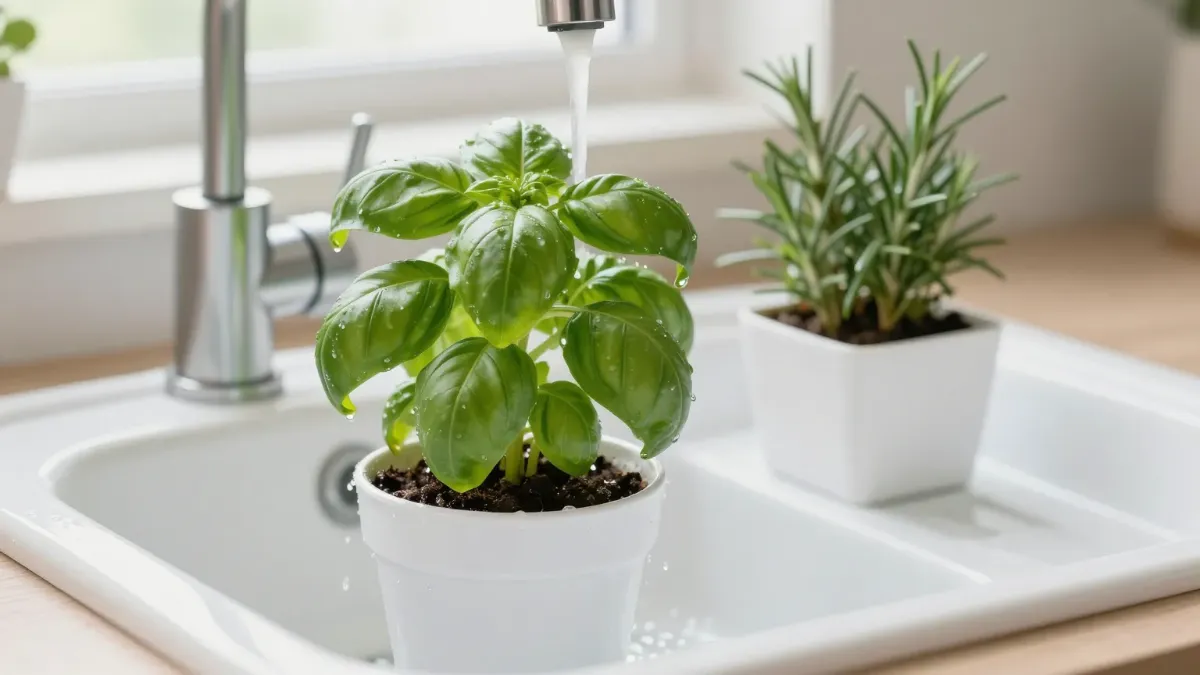
- Rinse the undersides. WSU says to rinse light to moderate infestations thoroughly in a sink or shower with lukewarm water, focusing on the leaf undersides, and to repeat at least weekly. UC IPM’s quick tips say to apply a water spray or mist to the undersides of the leaves of infested plants at least once a day. Iowa State says a forceful spray can dislodge mites and may reduce light infestations. NMSU says a pressurized spray also washes away the webbing, but some mites may climb back, so repeated washing may be needed. That is a wide range, and none of the pages test it on herbs, so we would call the rhythm a judgement call.
- Prune, or let the plant go. Iowa State says to prune heavily infested parts of larger plants first, and that it is often easier to discard a small, heavily infested plant than to restore it.
- Keep the plant healthy and the air from getting bone dry. WSU suggests resting pots on (not in) trays filled with pebbles and water, or misting daily, and warns not to overwater in an attempt to raise humidity. No source we read says humidity alone clears an infestation.
- Keep checking for several weeks. Colorado State University (CSU) Extension says spider mites on indoor plants develop from egg to adult in about two weeks. Our reading: that is one reason a single rinse is unlikely to finish the job, because mites you missed keep developing. Re-check the leaf undersides after each rinse.
Sprays and plants you eat
This is where sources disagree most. The pages we read are about houseplants, gardens or greenhouses. None of them test a spray on a windowsill herb.
- Cautious: WSU says chemical controls are not recommended on edible plants such as herbs and salad greens grown indoors for culinary use. The University of Vermont Extension Master Gardener guide calls insecticidal soap or horticultural oil a last resort if you plan to eat your herbs.
- Label-led: UConn Extension says many formulations of insecticidal soap can be used on various food crops up to the day of harvest, and tells readers to follow label instructions. That fact sheet is written for greenhouse crops (including herbs and vegetables) and indoor plants, not windowsill pots, so check the label of the exact product for your crop and for any wait before harvest.
If you do use a soap or oil, the pages agree on how they work. Minnesota and Iowa State say they kill only the mites they touch and have no lasting effect once dry, so repeat applications may be needed. UConn says soaps have less effect on eggs, which fits with the repeat advice (our reading). Coverage of the undersides matters, according to Iowa State and UC IPM.
They also agree that plants can be hurt. UC IPM says to test a product on one or two plants first and not to apply it to water-stressed plants or when temperatures are above 90 F. NMSU says to test on a small part of a plant a few days before spraying the whole plant. UConn describes yellow or brown spotting as a risk, especially for stressed plants and young transplants, and says hard water can make soap less effective and more toxic to the plant.
Homemade mixes: the sources we cite advise against them. Minnesota Extension says not to make homemade soap because it can burn plants, and Iowa State warns that concentrated liquid detergents with grease cutters have a high potential for harming plants. We are not giving a recipe.
People also search for rubbing alcohol, hydrogen peroxide, vinegar and garlic sprays. We found no extension page that recommends them for spider mites on edible plants, so we leave them out.
Here is how the options compare.
| Option | What it does | What sources say | Edible-plant note |
|---|---|---|---|
| Rinse the undersides | Knocks mites and webbing off | At least weekly (WSU) up to daily for infested plants (UC IPM quick tips); mites may climb back (NMSU) | Nothing applied to the plant |
| Prune or discard | Removes the worst of the mites | Iowa State: prune heavy infestations; discarding a small heavily infested plant is often easier | Nothing applied to the plant |
| Humidity and watering | Raises humidity; dry air favors mites (Iowa State) | WSU: pebble trays or daily misting, no overwatering | No source says it clears an infestation on its own |
| Insecticidal soap | Kills mites it touches; no lasting effect once dry | Repeat as needed (Minnesota); test first (UC IPM, NMSU, UConn) | WSU: not recommended on indoor edibles for cooking. Vermont: last resort. UConn: many formulations allowed up to harvest, check the label. |
| Horticultural or neem oil | Contact spray; no lasting effect | Minnesota: oils may be petroleum, vegetable or neem seed oil. NMSU: horticultural and neem oil sprays are labeled for spider mites on houseplants. | No page we read covers herbs you eat. Vermont: last resort. Follow the label. |
| Homemade dish-soap mix | Varies | Minnesota and Iowa State warn it can harm plants | No recipe given here |
| Predatory mites | Live predators of spider mites | Minnesota and CSU mention them; NMSU says predators are absent indoors | No page we read recommends releasing them on windowsill herbs |
Keeping them out
- Quarantine what comes in. WSU says to keep new plants, and plants moved indoors, isolated from your other indoor plants for about a month, and to inspect them regularly.
- Keep plants from getting stressed. UC IPM says water-stressed plants are highly susceptible, and Minnesota says mites thrive on plants under stress.
- Check leaf undersides now and then. Minnesota suggests checking garden plants every 3 to 5 days, especially under drought conditions. For a windowsill, a quick look under a few leaves when you water is our own cheap habit, not a rule from the sources.
New to this? Our indoor vegetable gardening guide for beginners is a good place to start, and how many basil plants per pot helps with setting up a new herb pot. If the pests you are fighting are outdoors on brassicas, see what is eating your broccoli.
Want a nudge on what to grow indoors this winter? Get our free Fall & Winter growing calendar.
Spider mites on indoor plants: FAQ
How do I get rid of spider mites on indoor herbs?
Extension sources start without sprays. WSU says to choose non-chemical options first and to rinse the plant thoroughly with lukewarm water, focusing on the leaf undersides, repeating at least weekly. UC IPM’s quick tips say to spray or mist the undersides of infested plants at least once a day. Keep checking for a few weeks.
Is it safe to spray insecticidal soap on herbs I eat?
Sources disagree. WSU says chemical controls are not recommended on indoor edible plants grown for culinary use, and the University of Vermont Extension Master Gardener guide calls soap a last resort. UConn Extension says many soap formulations can be used on food crops up to the day of harvest. Read the label of the exact product for your crop.
Will spider mites go away on their own?
The pages we read do not say they go away on their own. NMSU Extension says houseplants may die if a spider mite infestation is not treated, and CSU Extension says they develop from egg to adult in about two weeks on indoor plants. Our reading is that it takes repeated checking, not one rinse.
Why do I get spider mites in winter?
Iowa State Extension says dry indoor air and reduced plant vigor in winter seem to favor spider mites. WSU Extension says they thrive in the warm, dry conditions found in most homes and can arrive on new plants or plants brought inside.
How can I tell spider mites from dry leaves or drought stress?
University of Minnesota Extension says the symptoms may be confused with drought stress. Look under the leaves with a hand lens, or tap a stem over white paper and look for tiny moving specks, as Minnesota and Iowa State describe.
What about spider mites on indoor vegetable plants?
We found no extension page written for indoor vegetables. Minnesota lists cucumbers, snap beans, peas, tomatoes and lettuce as garden hosts. The checking and rinsing steps above are the same, and the caution about sprays on plants you eat applies.
Sources we checked
- Mites in Home Gardens. University of Maryland Extension, updated March 2026.
- Twospotted spider mites in home gardens. University of Minnesota Extension, J. Hahn and S. Wold-Burkness, reviewed 2020.
- Spider mites. Washington State University Extension, PestSense, last review January 2026.
- Spider Mites. Iowa State University Extension, Yard and Garden.
- Spider Mites on Houseplants. Iowa State University Extension, Yard and Garden, 2007.
- Growing Herbs Indoors. Iowa State University Extension, A. Steil, reviewed 2023.
- Spider Mites, Pest Note 7405. UC IPM, University of California.
- Spider Mites, Quick Tips. UC IPM, July 2025.
- Spider mites are common, but easily managed, pests of houseplants during the winter. New Mexico State University Extension, M. Thompson, Southwest Yard and Garden, January 2016.
- Soft Brown Scale and Spider Mites on Houseplants. Colorado State University Extension, PlantTalk Colorado 1464.
- Insecticidal Soaps. UConn Extension, L. Pundt, updated 2023.
- Indoor Herb Pests (archived copy). University of Vermont Extension Master Gardener.