What’s Eating My Broccoli? Aphids, Caterpillars and Slugs on Potted Broccoli
Quick answer: Turn a leaf over and look closely. Clusters of tiny soft insects under the leaves or in the head are aphids: blast them off with a strong stream of water, and repeat every day or two, because one hosing isn’t enough. Holes with green caterpillars and droppings nearby are cabbage worms, loopers or diamondback moth caterpillars: pick them off by hand and cover the pot so moths and butterflies can’t lay more eggs. Smooth-edged holes and shiny slime trails mean slugs or snails, which feed at night. Broccoli with a few aphids is still fine to eat once it’s washed well.
You went out to check your broccoli and found holes in the leaves, or a crowd of tiny bugs underneath. So what’s eating your broccoli leaves? On one plant in one pot, most of the usual culprits can be dealt with by hand. The trick is working out who did it, and the damage usually tells you.
This post contains affiliate links, meaning we may earn a small commission at no extra cost to you — full details are on our Affiliate Disclosure page.
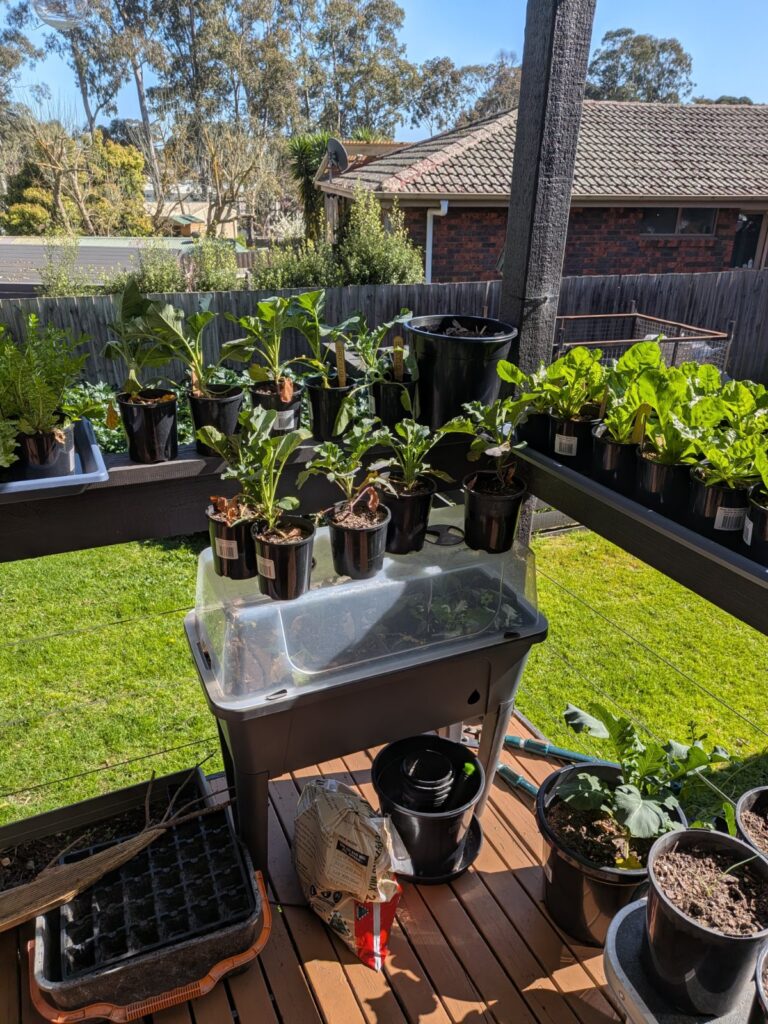
Our Test Garden is in the Southern Hemisphere, where broccoli is finishing in spring. The same pests turn up on US fall broccoli right now, and this month our own plant had most of them at once. You’ll see what we found further down.
In this guide: What you see and who did it · Aphids · Caterpillars · Slugs, snails and earwigs · Not a bug? · Is it safe to eat? · What we found · FAQ · Sources
What’s Eating Your Broccoli Leaves? Start With the Damage
Check three places: the undersides of the leaves, along the veins, and in the middle of the plant where the head forms. Do it once in daylight and once after dark, because several of these pests only come out at night.
| What you see | Likely culprit | First thing to do |
|---|---|---|
| Clusters of tiny soft-bodied insects under leaves or in the head (grey and powdery, green, or orange to reddish); sticky leaves; curled or yellowing leaves | Aphids | Strong spray of water, repeated every day or two; pinch off the worst leaves |
| Large, irregular holes; sluggish velvety green caterpillar; brown droppings; white butterflies with black spots around | Imported cabbageworm | Hand-pick; cover the pot |
| Large, ragged holes; light green caterpillar that loops as it walks; dark green droppings | Cabbage looper | Hand-pick; cover the pot |
| Small holes and see-through “windowpane” patches; tiny pale green caterpillar that thrashes or drops on a silk thread | Diamondback moth caterpillar | Hand-pick from the undersides; cover the pot |
| Irregular holes with smooth edges, appearing overnight; shiny silvery slime trails | Slugs or snails | Hand-pick after dark; board or beer trap |
| Irregular holes or leaves chewed around the edges, no slime; reddish-brown insect with “forceps” at the tail hiding under the pot | Earwigs | Check with a flashlight at night; rolled-newspaper trap |
| Shallow pits and tiny “shot holes” | Flea beetles | Look for very small beetles with big back legs |
| Round grey to black spots with rings, then holes where the spot falls out | Alternaria leaf spot (a fungus, not a bug) | Remove spotted lower leaves |
Aphids on Broccoli: Grey, Green or Orange Clusters
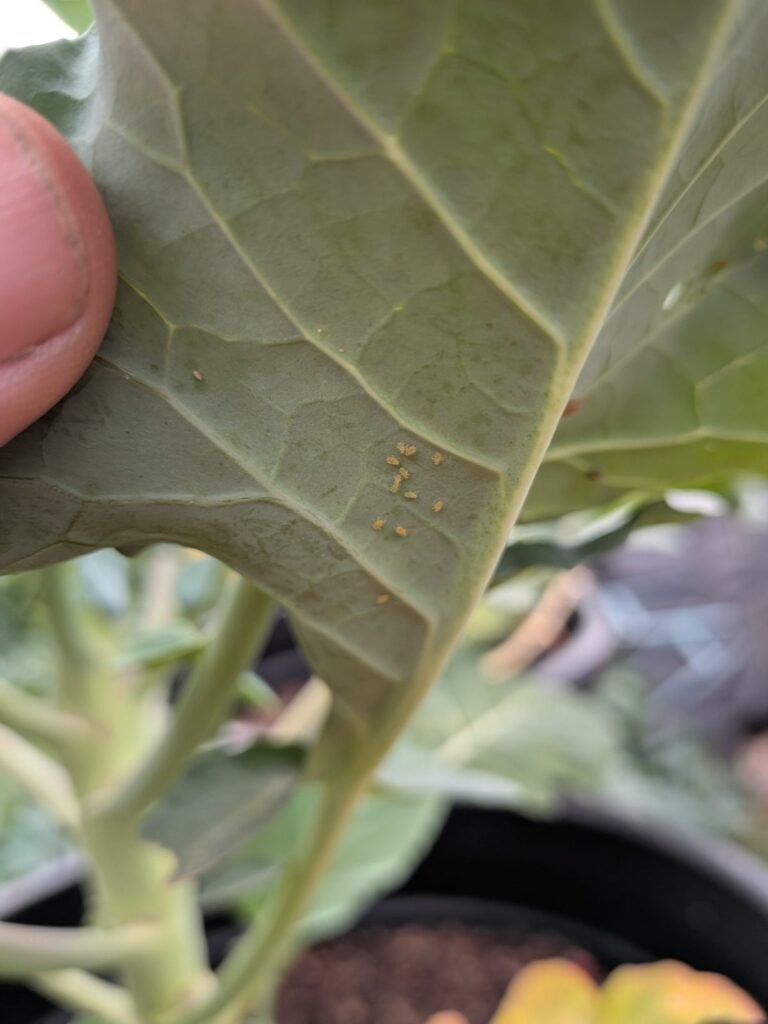
Aphids are small, pear-shaped, soft-bodied insects. On broccoli they feed under the leaves, in the buds and in the head itself (WSU). The one most guides picture is the cabbage aphid, which forms grey, powdery clusters (UC IPM). Don’t rule out aphids just because yours look different: aphids can be green, yellow, brown, red or black depending on the species and the plant, and most kinds also have winged forms, especially in spring and fall or when numbers are high (UC IPM). Ours were orange.
The damage: big populations can cause yellowing, stunted growth, and wrinkled or curled leaves (Clemson). Aphids also leave honeydew, a sweet, sticky material that can attract ants and later grow black sooty mold (WSU). Cabbage and turnip aphids are most common in cool, dry weather (NC State Extension), and Clemson notes they tend to be more common in fall.
Step 1: Water, and keep at it
Wash aphids off with a strong stream of water, and wipe small patches off by hand (WSU). Most dislodged aphids can’t get back onto the plant, and spraying early in the day lets the leaves dry fast in the sun (UC IPM). Aim under the leaves and into any curled growth in the center.
One hosing is rarely the end of it. Each adult aphid can produce up to 80 offspring in about a week (UC IPM), so the few you missed rebuild the colony fast. University of Maryland Extension suggests repeating the hose spray every 1 to 2 days, and pruning off and throwing away the worst-infested parts. We learned this one first-hand (see what we found).
Pot tip (our tip): a pot is easy to turn, or tip on its side, so the water reaches the undersides of the leaves without soaking the mix.
Step 2: Leave the helpers alone
Ladybugs, parasitic wasps and hoverfly larvae all eat aphids (NC State Extension), and spiders prey on brassica pests too (Clemson). If you see swollen, crusty, golden-brown aphids, leave them: those are “mummies,” with a tiny wasp growing inside (UC IPM). Small flowers such as sweet alyssum, parsley, dill, cilantro and fennel attract the parasitic wasps (Clemson), and a few of those fit in a pot next to your broccoli. More ideas in our guide to flowers and herbs that bring in helpful insects.
Watch for ants running up the stem. Ants guard aphids for their honeydew and fight off many of their predators (UC IPM).
Step 3: Insecticidal soap, only if they keep coming back
Insecticidal soap only kills the aphids it touches. Apply it when the leaves are dry, cover the whole plant including the undersides, and expect to repeat it, often every 8 to 10 days (WSU). Aphids hidden inside curled leaves won’t be hit (UC IPM). Don’t spray a plant that’s short of water, or when it’s above 90°F (UC IPM). University of Maryland Extension suggests spraying in the early morning or evening to avoid leaf burn. Always follow the label, including how long to wait before you harvest (WSU).
Go easy on nitrogen. High nitrogen levels help aphids breed, so never use more than the plant needs (UC IPM, WSU). Our soil and fertilizer basics guide covers slow-release feeds for pots.
Caterpillars: Cabbage Worms, Loopers and Diamondback Moths
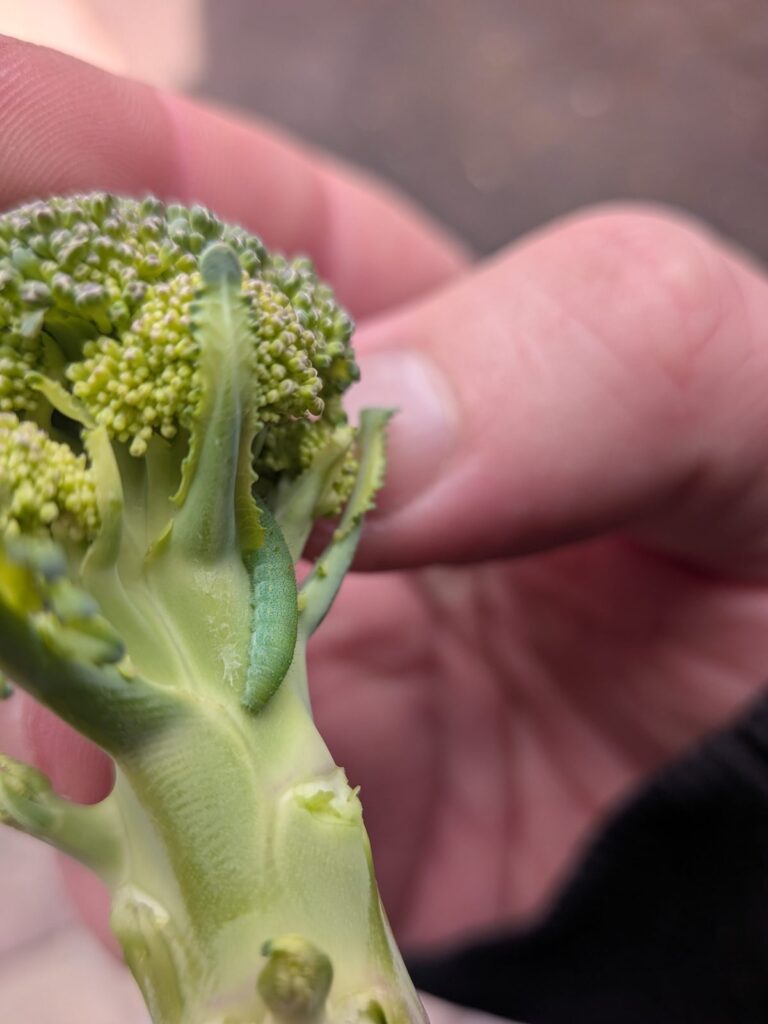
Three caterpillars come up most often in the extension guides for broccoli. Telling them apart helps a little, but the fix is the same for all three.
- Imported cabbageworm: a sluggish, velvety green caterpillar up to about 1 inch long with faint yellow stripes, leaving irregular holes and brown droppings (University of Minnesota Extension). The adult is the white or yellowish-white butterfly with black wing spots, and it lays yellowish eggs on the undersides of leaves (Illinois Extension). It also feeds on broccoli flowers (Illinois).
- Cabbage looper: light green, up to about 1½ inches, and moves with a “looping” action like an inchworm. It leaves large, ragged holes and dark green droppings (University of Minnesota), and its body is fatter at the tail end than the head (Clemson).
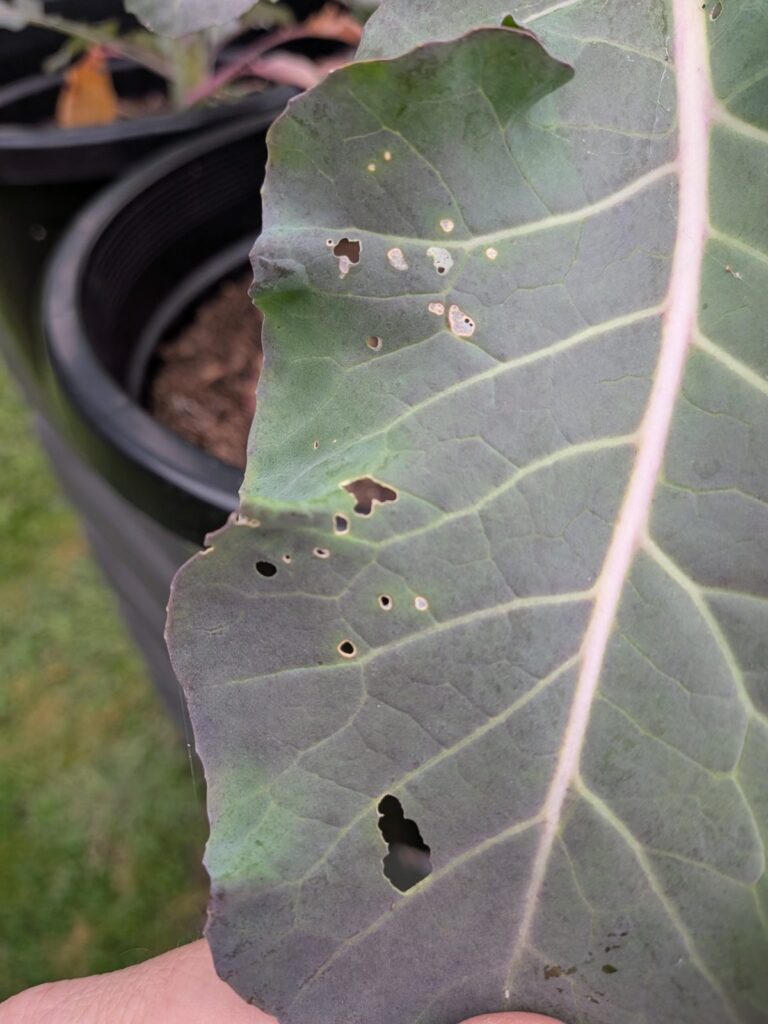
- Diamondback moth caterpillar: small and pale green, about ⅓ to ½ inch (University of Minnesota, Clemson). Disturb one and it thrashes about or drops and hangs from a silk thread (Clemson). It often doesn’t chew right through the leaf, leaving see-through “windowpane” patches (Clemson) that later fall out as small holes. Its feeding can also deform the heads (University of Minnesota).
What to do about caterpillars
- Hand-pick. For a small planting, picking caterpillars off works. Check every few days so you catch them soon after they hatch (Clemson); younger, smaller caterpillars are easier to manage than big ones (Illinois). Look under the leaves, along the stems and under the head.
- Cover the pot. A floating row cover stops butterflies laying eggs, and it can stay on until harvest, because broccoli doesn’t need insects to pollinate it (Illinois). Fine mesh netting does the same job in small plantings (Clemson). One pot is easy to cover. Pick the plant clean first, or you trap the caterpillars in with it (our tip). The Gardzen floating row cover is the one we list on our Recommended Gear page.
- Bt, if hand-picking can’t keep up. Bacillus thuringiensis (var. kurstaki or aizawai) is sold for caterpillars (Illinois). The caterpillar has to eat it, so aim it at young caterpillars that are actively feeding (Clemson, Illinois). Clemson lists it as safe for beneficial insects. Follow the label.
- Skip broad-spectrum sprays. They kill beneficial insects and spiders as well as the pests (Clemson, WSU).
Night Feeders: Slugs, Snails and Earwigs
If new holes appear overnight and you can’t find anyone in the daytime, go back out after dark with a flashlight.
Slugs and snails
Slugs and snails chew irregular holes with smooth edges, and the silvery slime trails they leave behind confirm it’s them and not caterpillars or earwigs. They’re active at night or on dark, cloudy days and hide by day in shade under plants, rocks, wood or compost (Utah State University Extension).
- Look under the pot, in the saucer and under anything stacked nearby. A pot sitting on a damp surface is a ready-made hiding place (our tip).
- Hand-pick. Water in the afternoon so they come out after dark, then remove them. Daily removal works best at first; once numbers drop, once a week keeps them down (USU).
- Traps. A 12 x 12-inch board with 1-inch strips nailed along two sides makes a good trap: check under it each morning (USU). For beer or yeast traps, covered, deeper containers work better than shallow pans (USU).
- Baits. Iron phosphate baits are less toxic to pets and other animals you want to protect and work better in damp weather. Metaldehyde baits can poison pets, and if you think a pet has eaten slug bait, call a vet straight away (USU).
Earwigs
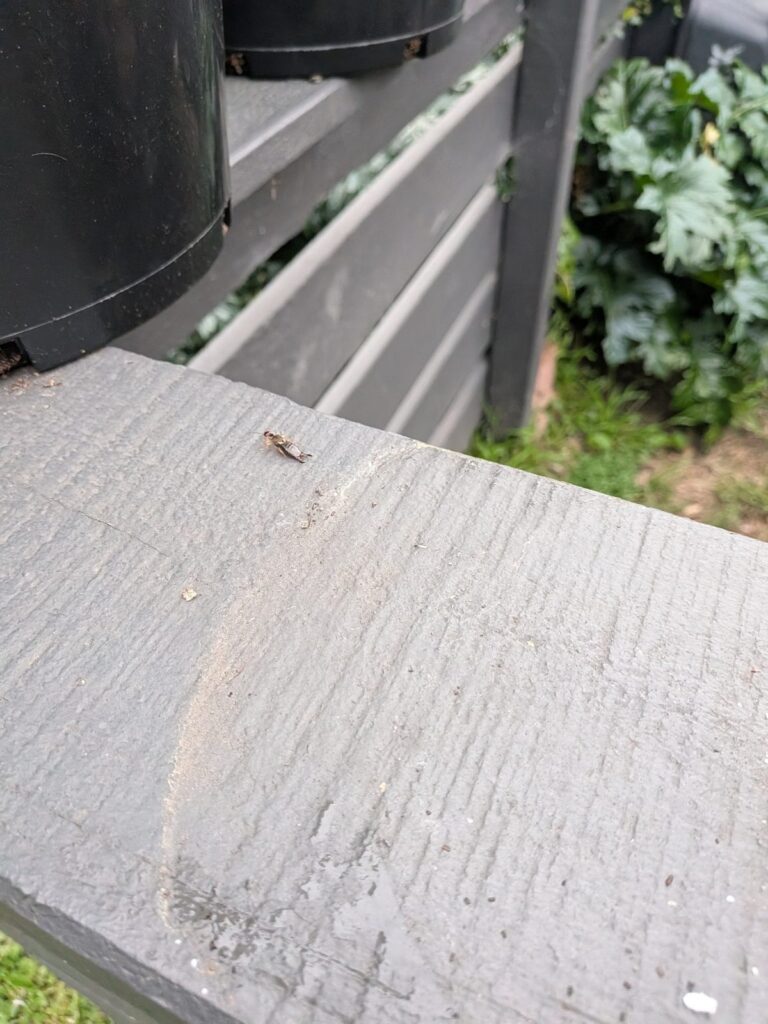
Earwigs are reddish-brown, about ¾ inch long, with a pair of “forceps” at the tail. On older plants they leave lots of irregular holes or chew leaves around the edges, which can look like caterpillar damage. They feed mostly at night and hide by day in dark, cool, damp places (UC IPM), and the space under a pot fits that well.
They’re not all bad: earwigs also eat soft-bodied insects such as aphids and insect eggs (UC IPM). So before you blame them, go out at night with a flashlight and see whether they’re actually on the leaves (UC IPM). If they are, set a rolled-up newspaper, a piece of corrugated cardboard or a short length of hose near the pot in the evening, and shake whatever collects into a pail of soapy water in the morning. Keep it up daily until you stop catching them, and clear away leaf litter and rubbish they can hide in (UC IPM).
Not a Bug? Two Look-Alikes
- Flea beetles make shallow pits and small, irregular holes that give a “shot hole” look. The adults are tiny, 1/16 to 1/8 inch, with enlarged back legs (University of Minnesota).
- Alternaria leaf spot is a fungus, not an insect. It starts as grey to black round spots with rings, on the older, lower leaves first. The dead patch dries out and falls away, leaving a hole (University of Minnesota). If your leaves are yellowing or wilting with no bugs at all, our guide to why container vegetables die covers the non-pest causes.
Is Broccoli With Aphids or Worms Safe to Eat?
Usually, yes. University of Maryland Extension says the aphids themselves aren’t dangerous to people, and broccoli is usually fine to eat once it’s washed thoroughly and damaged leaves are removed. For a heavily infested head, it suggests trimming hard, soaking it in salted water, rinsing well and cooking it rather than eating it raw.
Check the head before it goes in the pot. Our caterpillar was hiding right under a side shoot we’d just cut, and it would have been easy to miss.
What We Found on Our Test Garden Broccoli
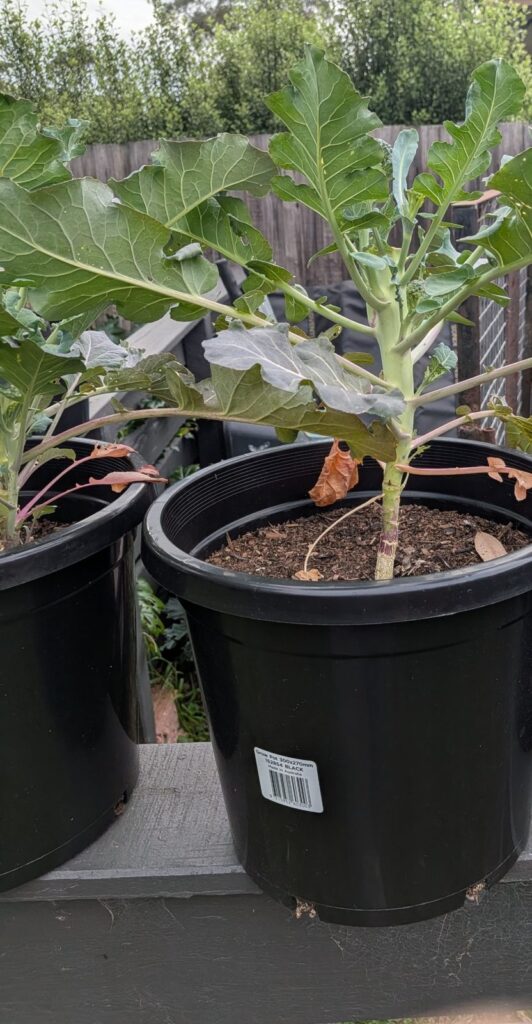
Our broccoli is in a 300 x 270 mm pot (about 12 inches across) and has been producing side shoots since we cut the main head. In mid-October we checked it closely, under the leaves and under the pot. Here’s what we found, and what we didn’t.
- Small orange aphids under several leaves, plus a winged one. Not the grey cabbage aphid, and we don’t know the species. We hosed them off and they were back within 3 days.
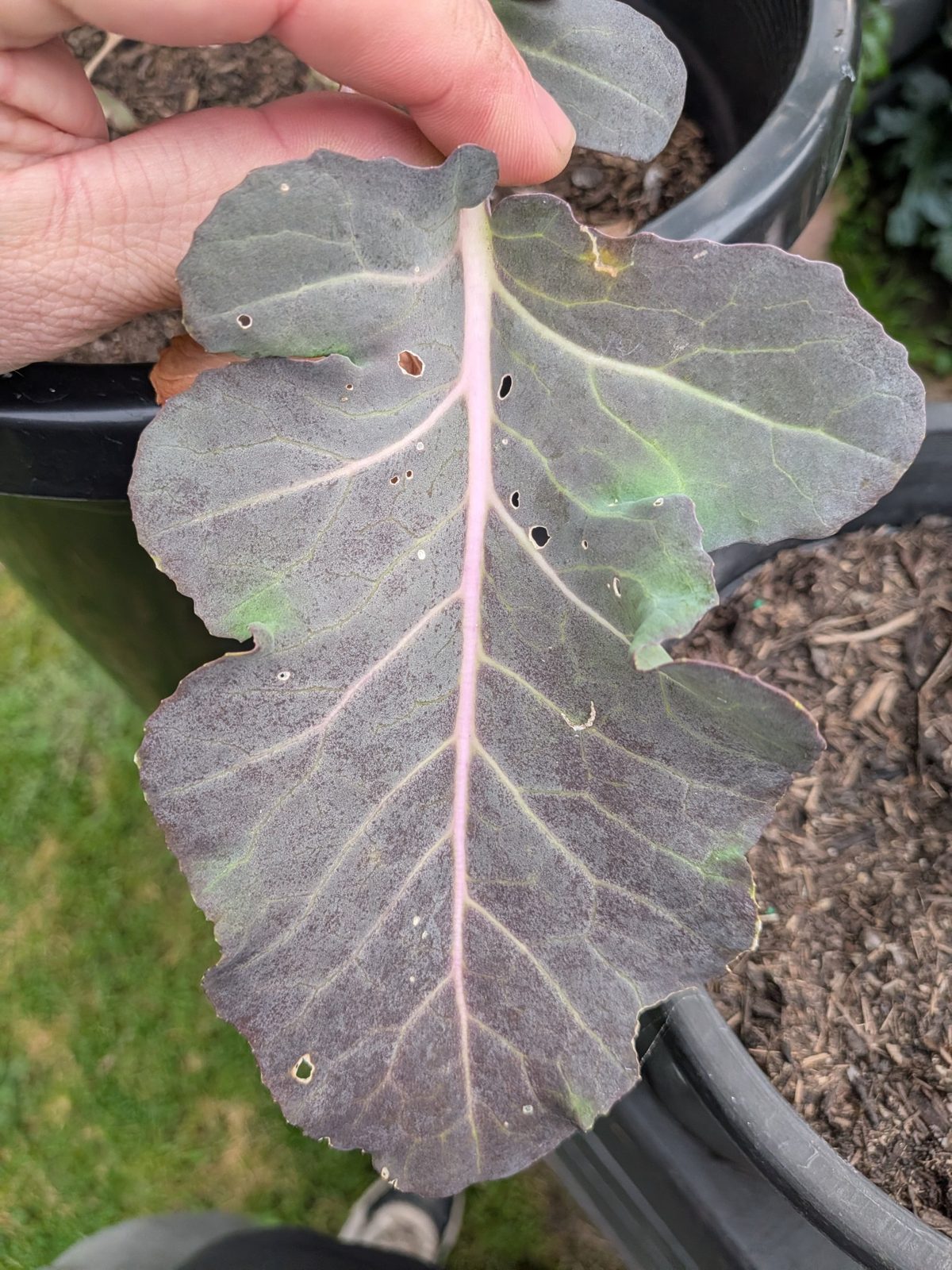
- Lots of small holes and windowpane patches, plus a small, slender brown moth sitting on a side shoot. The damage matches diamondback moth, and the moth may be one, but we couldn’t confirm it from our photo and haven’t found a diamondback caterpillar yet.
- A green caterpillar tucked under the head of the side shoot we harvested. It looks like a cabbage white caterpillar (imported cabbageworm). We also found green and dark droppings on the rail beside the pot.
- An earwig under the pot when we lifted it. We haven’t caught one on the leaves yet, so we can’t say it’s been eating them.
- No slime trails, so probably not slugs or snails.
- A spider web across the top of one leaf with an insect caught in it. One of the helpers at work.
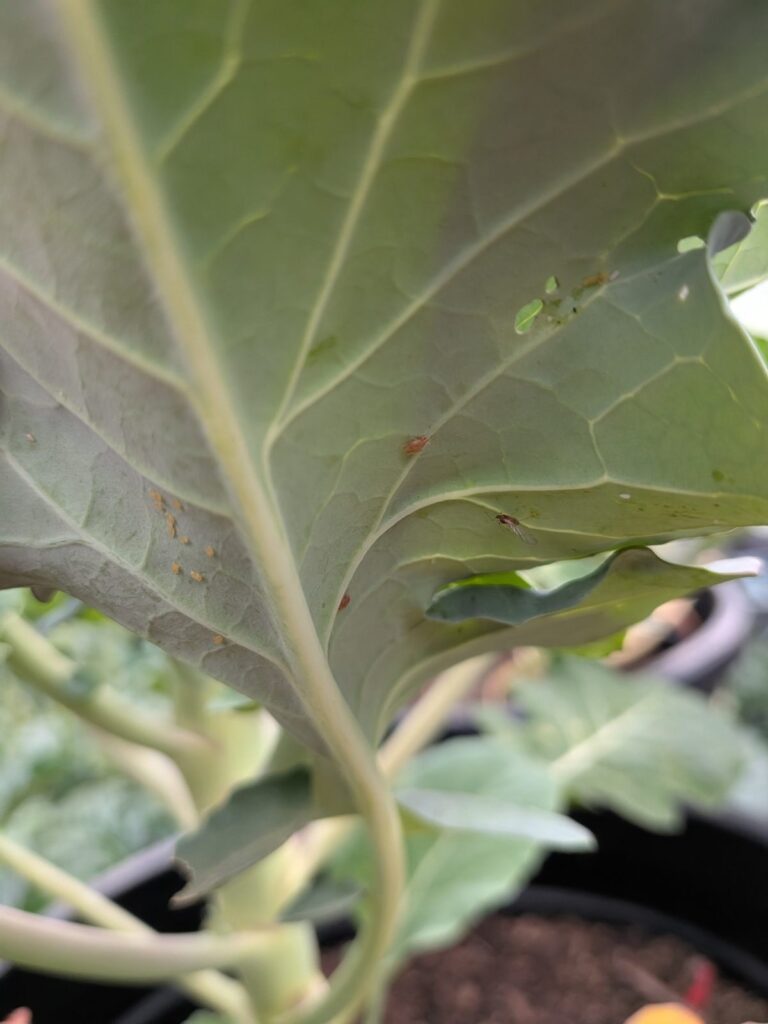
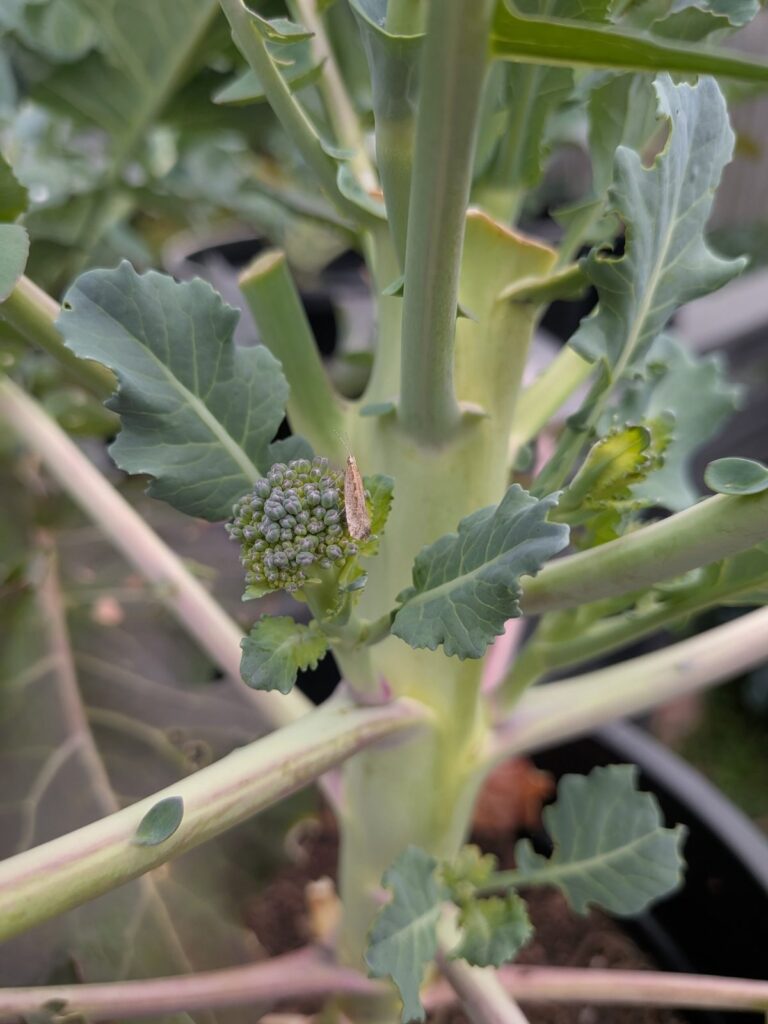
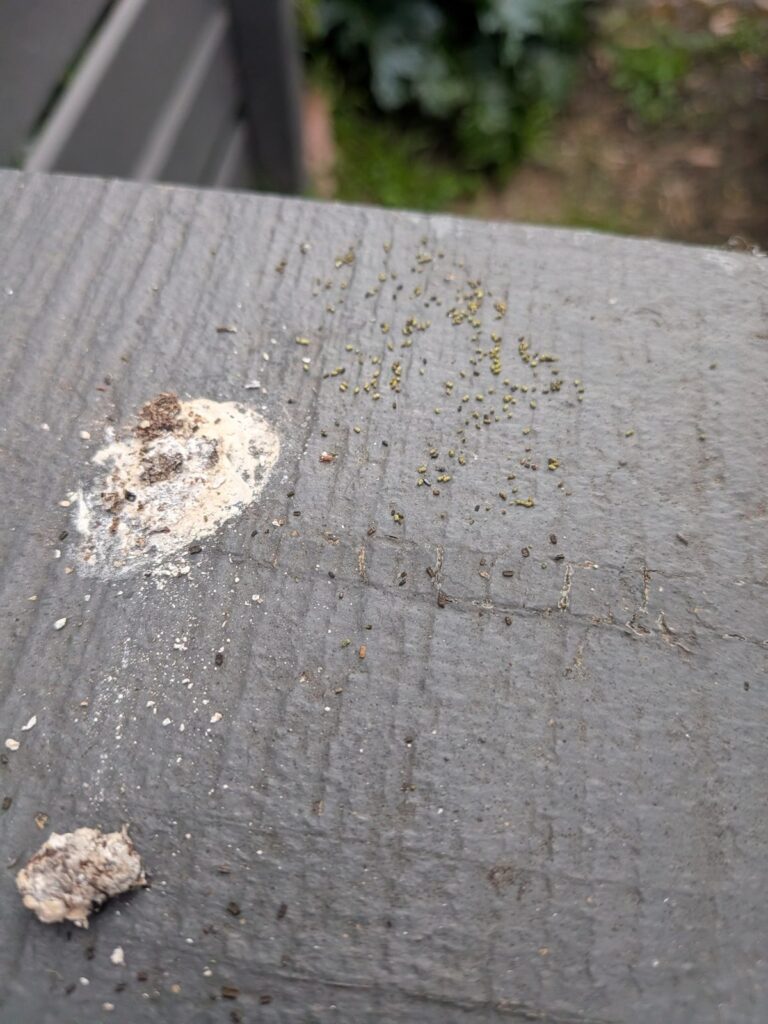
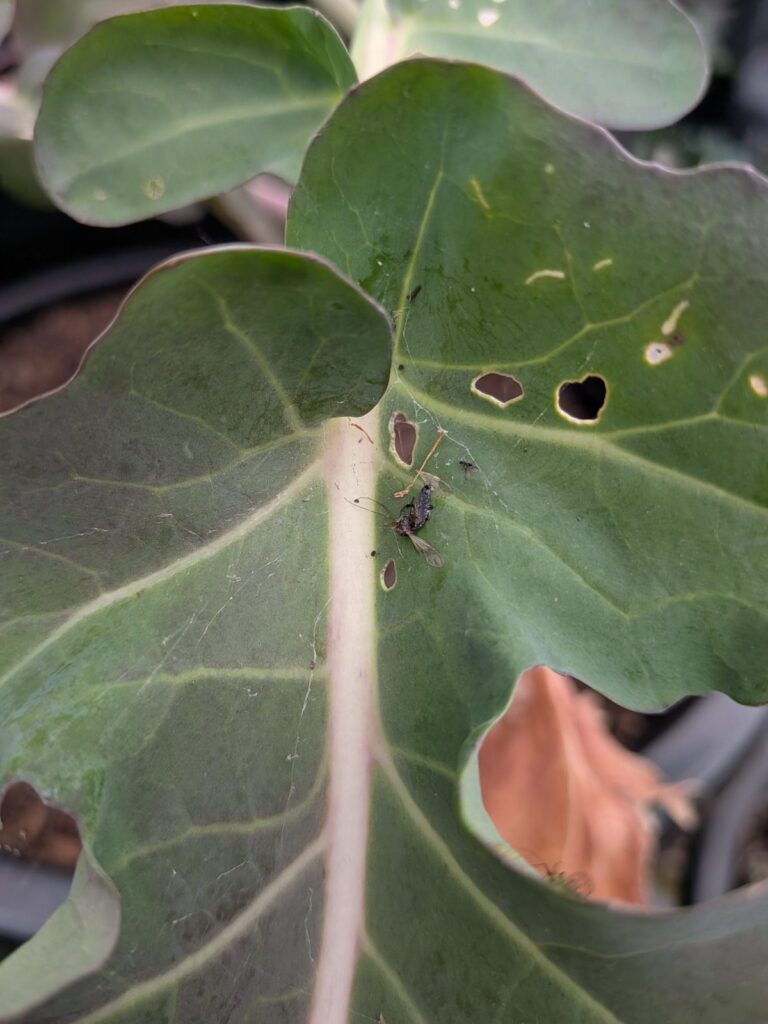
What we’re doing now: just checking the plant and hosing the aphids off again when they come back. We’ve already had the main harvest and the plant won’t last much longer, so it isn’t worth spraying anything. We’ll add a photo of the same plant a week on, and you can follow it in our Test Garden log.
Growing broccoli on a shadier balcony? It’s one of the vegetables that copes with partial sun: see our list of vegetables for a shady, north-facing balcony. And if you’re planning the rest of your season, start with our fall container garden guide.
FAQ
What is eating my broccoli leaves at night?
If holes appear overnight and you see shiny slime trails, it is almost certainly slugs or snails. With no slime, check for earwigs, which also feed at night and hide under pots by day. Go out after dark with a flashlight to see who is on the leaves.
Is broccoli with aphids safe to eat?
Usually, yes. University of Maryland Extension says aphids are not dangerous to people. Wash the broccoli thoroughly and remove damaged leaves. For a heavily infested head, trim hard, soak it in salted water, rinse well and cook it rather than eating it raw.
How do I get rid of aphids on broccoli without chemicals?
Knock them off with a strong stream of water and repeat every day or two, because the ones you miss breed quickly. Wipe small patches off by hand, prune off the worst leaves, and leave ladybugs, hoverfly larvae and golden-brown aphid mummies alone.
What are the green worms on my broccoli?
Usually imported cabbageworms, the caterpillars of the white cabbage butterfly. Cabbage loopers and diamondback moth caterpillars are also common. On a potted plant, all three can be picked off by hand. Check under the head before cooking.
Why does my broccoli keep getting aphids?
Cabbage and turnip aphids thrive in cool, dry weather, each adult can produce up to 80 young in about a week, and high nitrogen fertilizer helps them breed. Check the undersides of the leaves at least twice a week and avoid feeding more nitrogen than the plant needs.
Sources we checked
- UC IPM: Aphids (Pest Notes 7404)
- UC IPM: Earwigs (Pest Notes 74102)
- Washington State University Hortsense: Broccoli, Cole Crops: Aphids
- Clemson Cooperative Extension: Cabbage, Broccoli and Other Cole Crop Insect Pests
- NC State Extension: Controlling Aphids in Fall Vegetable Gardens
- University of Illinois Extension: Imported Cabbageworm
- University of Minnesota Extension: Holes in Cole Crop Leaves
- Utah State University Extension: Controlling Slugs and Snails
- University of Maryland Extension (via Ask Extension): Pest on Broccoli, Organic Options