How Many Basil Plants per Pot? Counts by Pot Size
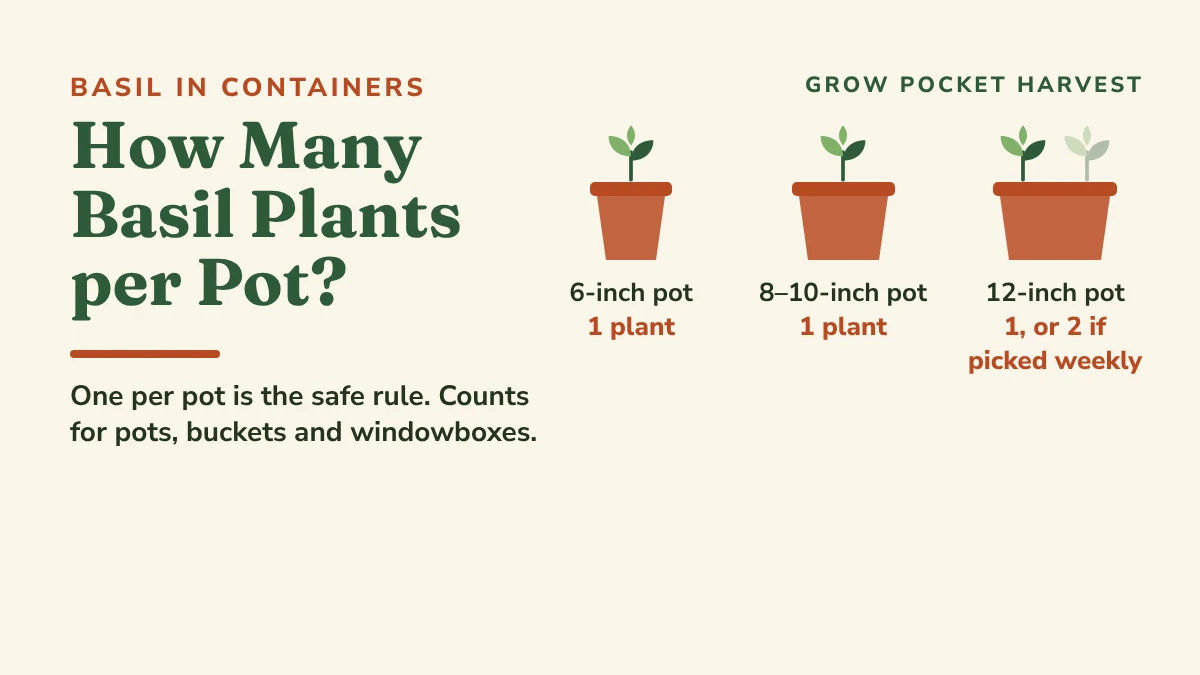
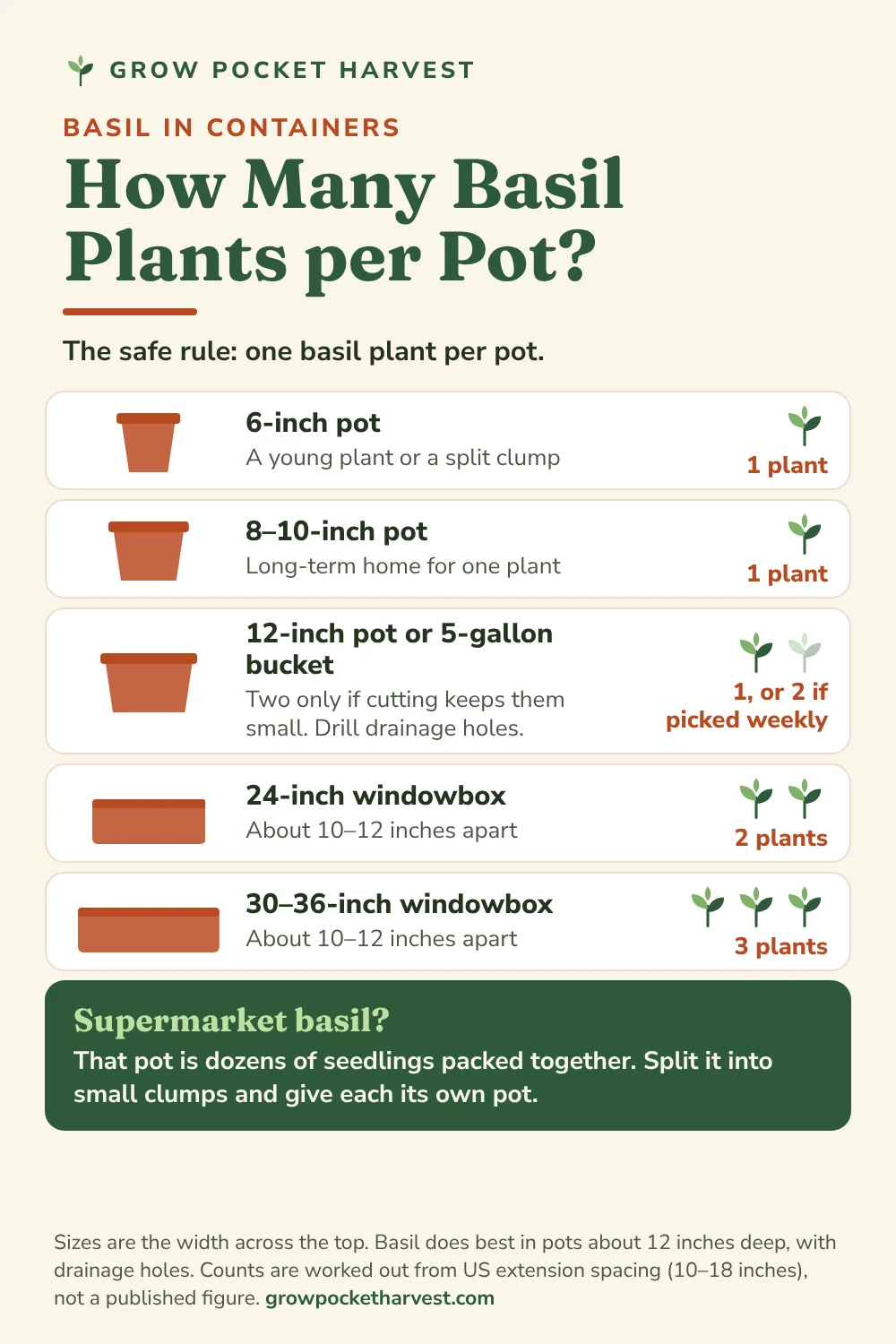
Quick answer: One basil plant per pot is the safe rule. A 6-inch pot holds one young plant; an 8–10 inch pot is a good long-term home for one full-size plant. A pot about 12 inches wide (or a 5-gallon bucket) can take two if you pinch them back every week, and a 24–36 inch windowbox fits two or three. That supermarket basil pot that looks like one plant is really dozens of seedlings: split it up and give each small clump its own pot.
Basil looks small when you buy it, so it’s tempting to fill a pot with several plants. Then a few weeks later the pot dries out by lunchtime, the stems stretch and the leaves shrink. Most of the time the problem isn’t care. It’s crowding.
Below are plain counts by pot size, how we worked them out, and what to do with a crowded grocery-store pot. No extension service publishes a “plants per pot” number for basil, so we started from the spacing and pot sizes university extension services do publish (named as we go) and did the arithmetic. Where we’re using judgement, we say so.
This post contains affiliate links, meaning we may earn a small commission at no extra cost to you. Full details are on our Affiliate Disclosure page.
In this guide: Counts by pot size · Why one plant per pot · Splitting supermarket basil · Starting from seed · Signs of too many · Keeping it going · FAQ
How many basil plants per pot, by pot size
Sizes are the width across the top of the pot. “Full-size” means a regular sweet or Genovese basil; “compact” means a small-leaved dwarf type such as ‘Spicy Globe’.
| Container | Basil plants | Notes |
|---|---|---|
| 4–5 inch pot (nursery or supermarket size) | 1, short term | A holding pot. Move it up within a few weeks. |
| 6 inch pot | 1 | Fine to start a seedling or a split clump. |
| 8–10 inch pot | 1 | A long-term home for one full-size plant. |
| About 12 inches wide | 1 full-size, or 2 if pinched weekly | Two compact plants fit more easily. |
| 5-gallon bucket (about 12 inches across) | 1–2 | Same as a 12-inch pot. Add drainage holes. |
| 24 inch windowbox | 2 | About 10–12 inches apart. |
| 30–36 inch windowbox | 3 | About 10–12 inches apart. |
These counts are our own working from extension spacing and pot-size advice, not a published figure. See “How we got the counts” below.
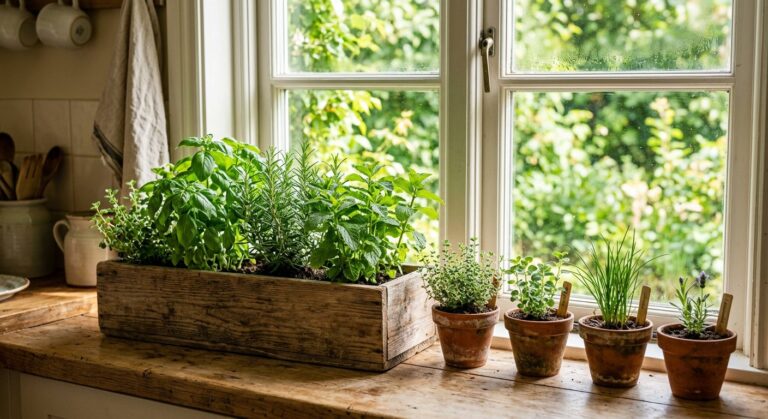
Depth matters too. UC Master Gardeners (Stanislaus County) suggest basil pots at least 6–8 inches wide and 12 inches deep. A shallow 6-inch pot is fine for a young plant, but for a plant you want to keep picking all season, go deeper and wider. Most windowboxes are shallower than the 12 inches UC suggests, so they dry out faster; check them daily in warm weather. Whatever you use needs drainage holes (see our pot size and drainage guide). Our companion herbs guide spaces mixed herbs 6–8 inches apart in a windowbox; that works for basil only if you pinch it often, so it doesn’t crowd its neighbors.
Why one basil plant per pot is the safe rule
Basil gets bigger than it looks. In the ground, extension spacing for basil runs from 10–18 inches between plants (West Virginia University Extension) up to 2 feet (University of Illinois Extension and Clemson’s Home & Garden Information Center). Clemson notes that ‘Genovese’ can reach 3–4 feet tall in a garden. A pot keeps it smaller, but the roots still want room.
How we got the counts. We took the low end of West Virginia’s range, about 10 inches per plant, and treated each plant as needing roughly a 10-inch circle. That gives one plant in anything up to about 10 inches wide, and two or three in a long windowbox. The “two in a 12-inch pot” line leans on UMass Extension’s fact sheet for commercial growers, which lists 6–12 inches between plants in double rows on beds that are harvested often. Close spacing works if you keep cutting; leave it alone and two plants will crowd each other.
Mississippi State agrees. Its “grow a salad on your front porch” plan puts one sweet basil plant in a 16-inch pot shared with other salad plants, and says to put any extra seedlings in other containers.
Small pots dry out fast. University of New Hampshire Extension warns that containers that are too small dry out quickly and cause wilting, while pots that are far too big can stay wet and lead to root rot. Basil is one of the herbs that hates drying out: Penn State Extension says never to let its potting mix dry out completely. Several plants in one small pot use up the water even faster.
Air helps. Illinois Extension says good spacing lets air move between plants, which lowers the risk of disease.
Why supermarket basil dies, and how to split it
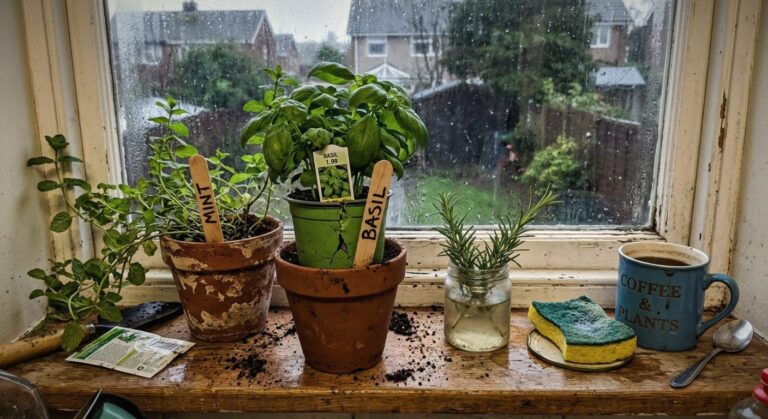
That pot of living basil from the grocery store isn’t one plant. GrowVeg describes it as “dozens of seedlings crammed together into a tiny pot,” grown fast under greenhouse conditions to look full on the shelf. The BBC’s Gardeners’ World says the same: many young plants tightly packed into each pot. (Both are UK gardening sources; we found no US extension guide on this.) Once it’s home on a windowsill, all those seedlings compete for the same small rootball.
To split it:
- Water it first, then ease the whole rootball out of the pot.
- Pull it gently apart. Gardeners’ World suggests several small clumps, each with a good set of roots; GrowVeg separates basil into single seedlings. Small clumps are easier and less fiddly; either works.
- Pot each one on its own in fresh potting mix (we link Espoma potting mix), at the same depth it was growing before. A 4–6 inch pot is plenty to start.
- Water well and give it light. GrowVeg says basil is “pretty robust and should bounce back.” Gardeners’ World suggests cutting back most of the soft upper growth to just above the lower buds.
- Pot up later. Move the strongest plants into 8–10 inch pots, one per pot, once roots show at the drainage hole.
One crowded pot can become several plants this way. Some clumps may not take, so split into more than you need.
Starting from seed: sow a few, keep one
Clemson HGIC says to sow basil seeds ¼ inch deep, with germination in 5 to 10 days at 70°F. Seeds don’t all come up, so sow three or four per pot. Once the seedlings have a couple of sets of true leaves, keep the strongest and snip the others off at soil level with scissors; pulling them can disturb the roots of the one you keep.
Basil is warm-weather food. Penn State says it can’t survive temperatures below 50°F, and Iowa State Extension recommends warm temperatures (about 75°F) for germination. If you’re sowing in fall or winter, that means indoors.
Signs you have too many basil plants in one pot
- The pot dries out within a day of watering and the plants wilt.
- Tall, thin stems with small, pale leaves as the plants race each other for light. (On a dim windowsill, low light causes this too: Penn State says herbs grown in too little light become thin and spindly.)
- Roots poking out of the drainage hole soon after planting. Our root-bound guide covers what to do next.
- Lower leaves yellowing and dropping, often from crowding and shade (overwatering can cause this too).
The fix is the same as for supermarket basil: split them up, or keep the strongest and remove the rest.
Keeping one plant per pot producing
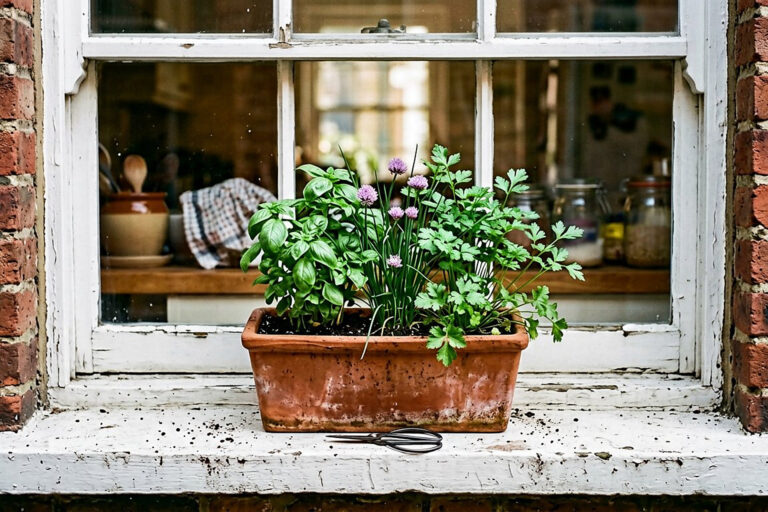
Pick from the top, every week. West Virginia University Extension suggests clipping the top 2–3 inches of the stem tips about once a week, leaving roughly 4 leaves, which makes the plant branch and keeps it from flowering. Illinois Extension says to cut just above a pair of leaves and leave at least half the plant; new growth appears at the cut within about a week. Regular picking is also what lets two plants share a 12-inch pot.
Pinch off flower buds. Clemson HGIC says to pinch them out as soon as they appear. Illinois Extension notes that flowering makes basil woody and the leaves bitter. More in our basil, rosemary and mint windowsill care guide.
Indoors in winter, light is the limit. Penn State says most herbs need about 6 hours of direct sun or, under fluorescent tubes, 6–12 inches below the lights for 14–16 hours a day (for an LED light, follow the maker’s distance), and that basil shouldn’t sit on a cold windowsill in winter. Iowa State adds that basil grown indoors tends to have a milder flavor and scent. A small clip-on grow light can cover one or two small pots (check the maker’s stated coverage); our guide to grow lights for small-space herbs compares options.
Growing more than basil? Our companion herbs windowbox guide covers which herbs share a box, and the Thanksgiving herbs guide covers timing for holiday cooking. Same idea for salad: how many lettuce plants per container. And for leafy greens: how many spinach, chard and kale plants per container.
Want a nudge on what to grow indoors this winter? Get our free Fall & Winter growing calendar.
Frequently asked questions
How many basil plants can I grow in a 5-gallon bucket?
One full-size basil plant, or two if you pick them every week. A 5-gallon bucket is about 12 inches across. Garden spacing for basil is 10 to 18 inches, so two plants only work if regular cutting keeps them small. Drill drainage holes in the bottom first.
Can you plant two basil plants in one pot?
Only in a wide pot, about 12 inches across or more, and only if you harvest often. In a 6 to 10 inch pot, stick to one plant. Two plants in a small pot dry it out quickly and crowd each other.
Should I separate supermarket basil?
Yes. A supermarket pot is many seedlings packed tightly together. Water it, ease out the rootball, gently pull it into several small clumps (or single seedlings), and pot each one on its own in fresh potting mix.
What size pot does one basil plant need?
A 6-inch pot is fine for a young plant. For a plant you want to keep all season, use an 8 to 10 inch pot. UC Master Gardeners suggest at least 6 to 8 inches wide and 12 inches deep, with drainage holes.
Why is my potted basil tall and leggy?
Usually too little light, too many plants in the pot, or both. Give it more light (about 6 hours of direct sun, or a grow light for 14 to 16 hours indoors), thin to one plant per pot, and pinch the stem tips back every week so it branches.
Can I grow basil indoors in winter?
Yes, with enough light and warmth. Penn State Extension says basil can’t survive below 50 degrees F, so keep it off cold windowsills in winter and use a grow light if your window gets less than about 6 hours of direct sun.
Sources we checked
- West Virginia University Extension (Lewis W. Jett), Growing Basil in West Virginia
- University of Illinois Extension (Brittnay Haag), Growing Basil in Your Backyard (2020)
- Clemson Cooperative Extension, Home & Garden Information Center, Basil, HGIC 1327 (updated 2019)
- UMass Extension Vegetable Program, Basil fact sheet (commercial growers; 2013)
- Penn State Extension, Growing Herbs Indoors (updated 2024)
- Iowa State University Extension, Growing Basil in the Home Garden (reviewed 2025)
- University of New Hampshire Extension, Growing Herbs in Containers (2018)
- UC Master Gardeners of Stanislaus County (Terry Pellegrini), The Joy of Culinary Herbs (2020)
- Mississippi State University Extension (Natasha Haynes), Grow a Salad on Your Own Front Porch, M2121
- GrowVeg (UK source, Jeremy Dore), The Real Reason Supermarket Basil Always Dies (2026)
- BBC Gardeners’ World (UK source, Dylan Turner), How to divide supermarket herbs (2021)