Best Fall & Winter Vegetables to Grow in Containers
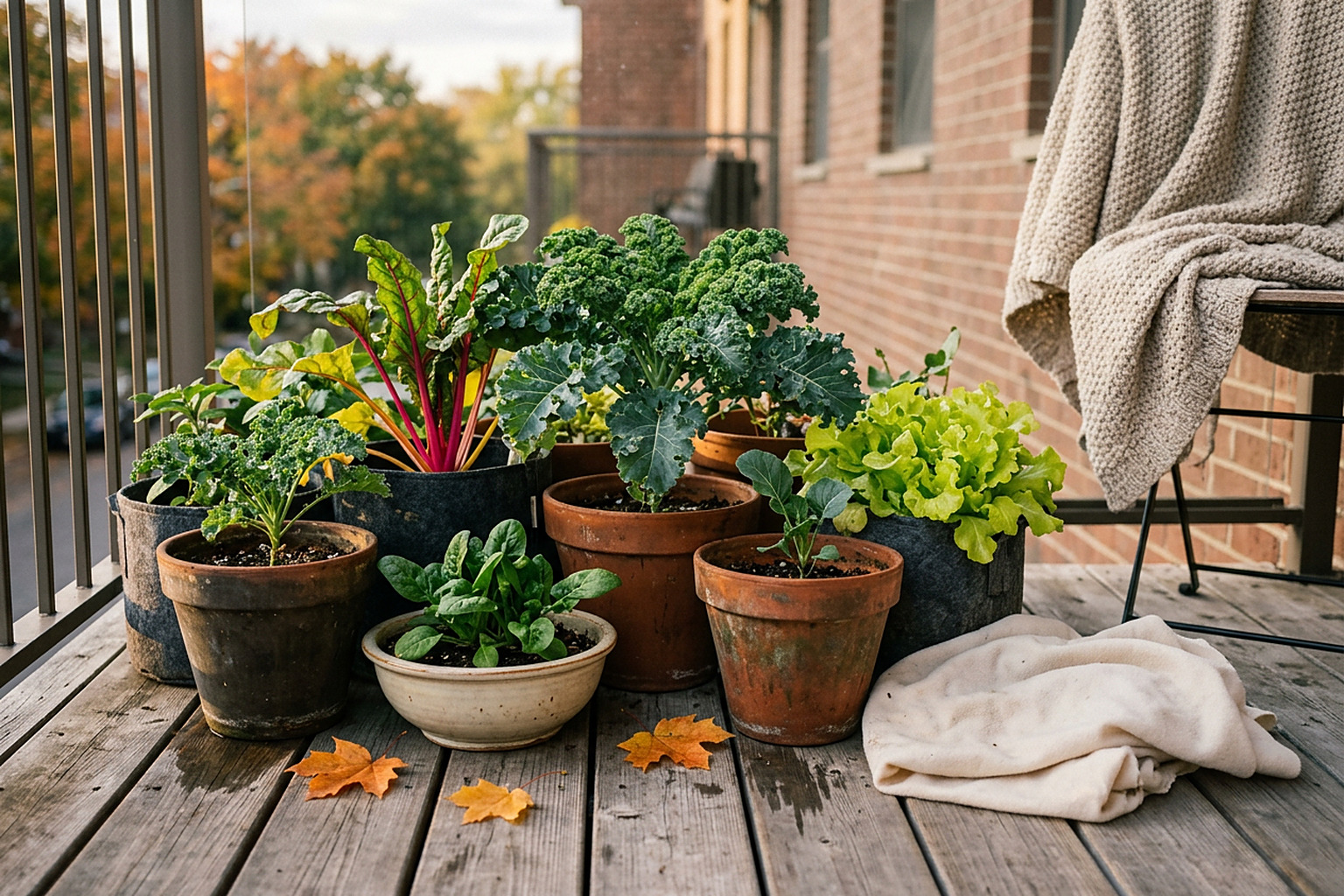
Summer’s tomatoes are winding down, but your balcony garden doesn’t have to go quiet. A surprising number of vegetables actually prefer cool weather. Some even taste sweeter after a frost. Below you’ll find the best fall and winter vegetables for containers, with pot sizes, days to harvest, how cold each one can take, and whether it’s still worth planting seeds this late in September or whether you should buy starter plants instead.
This post contains affiliate links, meaning we may earn a small commission at no extra cost to you — full details are on our Affiliate Disclosure page.
Quick Answer: The Best Cold-Hardy Container Crops
If you only read one section, read this one. The easiest fall container crops for beginners are spinach, kale, arugula, leaf lettuce, and radishes. They grow fast, fit in small pots, and handle light frost. For something to harvest next summer, plant garlic now. The table below is a quick reference. Temperatures are rough guides for established plants and describe what the leaves can take. Roots in a pot are more exposed, so treat the lower numbers as the point where you add protection.
| Crop | Min. container | Days to harvest | Approx. cold tolerance | Late-September start |
|---|---|---|---|---|
| Spinach | 2 gal, 6″ deep | 25–30 (baby), 40–50 (full) | Below 28°F; very hardy | Seed (most zones) |
| Kale | 3–5 gal, 10–12″ deep | 25–30 (baby), 55–65 (full) | Low-to-mid 20s°F and often colder | Transplant (seed only in zones 7+) |
| Leaf lettuce / mesclun | 2 gal, 6″ deep | 25–30 (baby), 40–50 (heads) | 28–32°F | Seed for baby leaf; transplants for heads |
| Arugula | 2 gal, 6″ deep | 20–25 (baby), 35–40 (full) | Below 28°F | Seed |
| Bok choy | 2–3 gal, 8″ deep | 30 (baby), 45–60 (full) | About 28°F | Seed for baby; transplants for full size |
| Tatsoi | 2 gal, 6″ deep | 21–25 (baby), 40–50 (full) | Upper 20s°F or a bit lower | Seed |
| Radishes | 2 gal, 6″ deep | 22–30 | About 28°F | Seed |
| Green onions / scallions | 1–2 gal, 6″ deep | 60–70 from seed; 2–3 weeks regrowing roots | Below 28°F | Transplants or regrown roots |
| Swiss chard | 3–5 gal, 10″ deep | 30 (baby), 50–60 (full) | 28–32°F | Transplant |
| Mâche (corn salad) | 2 gal, 4–6″ deep | 45–60 | Below 28°F; among the hardiest | Seed |
| Garlic | 3–5 gal, 8–10″ deep | About 8–9 months (harvest early summer) | Below 28°F | Plant cloves mid-fall |
| Parsley | 1–2 gal, 8″ deep | 70–90 from seed | 28–32°F | Transplant |
| Cilantro | 2 gal, 8″ deep | 30–40 for leaves | Light frost (upper 20s°F) | Seed |
The cold-tolerance ranges come from extension frost-tolerance lists. South Dakota State University Extension groups lettuce, spinach, radish, parsley, garlic, and Swiss chard as tolerating light freezes of 28–32°F, and kale and Chinese cabbage as tolerating moderate freezes of 24–28°F. Oregon State University Extension goes further and lists spinach, kale, arugula, corn salad (mâche), radish, onions, and garlic as tolerating heavy frost below 28°F. The two lists don’t agree on every crop, which is normal. Variety, how established the plant is, and how quickly the cold arrives all make a difference. The numbers are a guide, not a guarantee.
First, Find Your First-Frost Date (and Count Back)
Your timing depends on where you live. Look up your average first fall frost date by ZIP code (your county extension office or a frost-date lookup tool will have it). Then count backward from that date.
Virginia Cooperative Extension gives a simple formula for fall planting dates. Add up:
- Days to maturity from the seed packet (or from transplanting, if you’re buying starts)
- Your harvest window: how many days you want to keep picking
- A “fall factor” of about two weeks, because plants grow more slowly in cooler weather and shorter days
Here’s an example. Say your first frost is October 25 and you want full-size spinach (about 45 days). Add 14 days for the fall factor and you get 59 days. Count back 59 days from October 25 and you land in late August. That was the ideal date. It doesn’t mean you’ve missed out, though. Spinach can handle frost, so the first-frost date isn’t a hard deadline for it. You can switch to baby leaves (25–30 days), start with transplants, or cover the pot with frost cloth to keep it growing into November.
What’s realistic in late September, by zone
- Zones 3–5 (first frost often mid-September to early October): It’s late for seed. Sow only the fastest crops (radishes, arugula, baby spinach, mâche), buy transplants of kale or chard if you can still find them, and plant garlic in October.
- Zones 6–7 (first frost roughly mid-October to early November): You still have a good window. Sow spinach, arugula, lettuce mix, tatsoi, radishes, cilantro, and mâche now. Use transplants for kale, chard, parsley, and full-size bok choy.
- Zones 8–10 (first frost late November or later, or rare): Fall is your main growing season. You can seed almost everything on this list and keep sowing through October.
Frost dates vary within a zone, so check your own date.
Why Containers Get Colder Than the Ground
This is the part most fall planting guides skip. Garden soil holds heat, and roots in the ground are surrounded by it. A pot is exposed to cold air on every side, including underneath if it’s up on a railing or stand. According to University of Illinois Extension, most plants’ roots are far less cold hardy than their stems and leaves, and the small amount of soil in a container “will get much colder than soil in a landscape.”
So kale that could handle 20°F in the ground may struggle at that temperature in a small pot, especially after several cold nights in a row. Here’s how to help your containers:
- Go bigger. More soil holds more heat. A 5-gallon pot stays warmer overnight than a 1-gallon pot.
- Group pots together against a wall, ideally one facing south or west that soaks up afternoon sun. Illinois Extension recommends grouping containers in a sheltered spot and mulching them heavily.
- Keep the soil moist before a freeze. Illinois Extension notes that moist growing media freezes more slowly than dry media. Water in the morning, not at night. Our watering guide covers how to check the soil.
- Wrap the pot, not just the plant. Bubble wrap, burlap, or an old blanket around the outside of the container insulates the roots. A few inches of shredded leaves or straw on the soil surface helps too.
- Get pots off cold concrete with pot feet or a scrap of wood, and move them away from windy corners.
- Have a backup spot. On the coldest nights, carry small pots into an unheated garage, stairwell, or entryway, then bring them back out in the morning. See growing vegetables in your garage if you want a longer-term setup. Plants worth keeping all winter can come inside for good: see bringing your container garden indoors for winter.
For the plants themselves, frost cloth is the most useful tool. UConn Home & Garden Education Center says floating row covers add about five degrees of protection, and thicker fabrics can protect some crops down to about 25°F. A 1.5 oz frost cloth is a good weight for balcony pots. Drape it over the plants and clip or tie it to the rim, or tuck it under the pot. It lets light and water through, so you can leave it on for several days during a cold spell. For a full step-by-step, see our frost protection guide for containers.

The Best Fall & Winter Vegetables for Containers
1. Spinach
If you grow one fall crop, make it spinach. It’s among the hardiest greens on this list and grows well in shallow containers. According to University of Wisconsin–Madison Extension, small crops like spinach, leaf lettuce, radishes, cilantro, and green onions need a container of at least two gallons and four to six inches deep. UConn recommends varieties such as ‘Winter Bloomsdale’ and ‘Giant Winter’ for hardiness, and notes that spinach will simply wait out the coldest weeks and start growing again in early spring. Sow seeds now in most zones and pick outer leaves at baby size. Our spinach on a balcony in fall guide walks through it step by step.
2. Kale
Kale handles cold better than almost any other crop on this list, and many growers find it tastes sweeter after a frost. It gets big, so give each plant a 3- to 5-gallon pot. By late September, start with transplants unless you’re in zone 7 or warmer, because full-size kale from seed needs about two months. UConn highlights ‘Winterbor’ as a reliable cold-season variety. If you’re short on time, sow a pot of kale thickly and harvest it as baby greens in about four weeks.
3. Leaf lettuce and mesclun
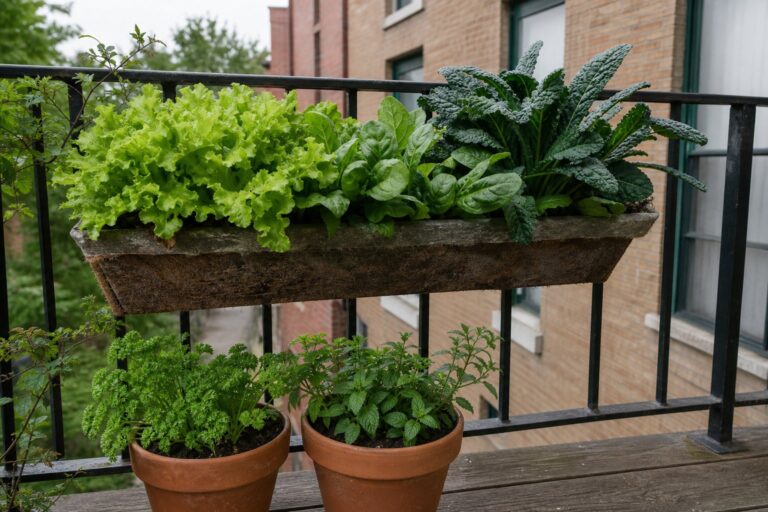
Lettuce is less hardy than spinach or kale (28–32°F is its comfort floor), but it’s quick and easy. Loose-leaf types and mesclun mixes work best this late. Sow them thickly and cut the leaves with scissors once they’re 3–4 inches tall. They’ll regrow for a second and third cutting. Not sure how many to plant? See how many lettuce plants per container. Put frost cloth over your lettuce before your spinach, because lettuce will show damage first.
4. Arugula
Arugula is one of the fastest greens you can grow. It’s often ready to pick three weeks after sowing, and Oregon State lists it among the heavy-frost-tolerant crops. It’s also much less likely to bolt (go to seed) in cool fall weather than in summer. Any 2-gallon pot or window box works.
Arugula is also quick to flower once days lengthen and warm up. If yours sends up a stalk, see why is my arugula bolting? for what to do with it.
5. Asian greens: bok choy and tatsoi
Bok choy and tatsoi grow fast and make great stir-fry greens. Baby bok choy is ready in about a month from seed. Full-size heads take closer to two months, so buy transplants if you want those. The extension lists don’t agree on Chinese cabbage (the group bok choy belongs to): SDSU puts it in the moderate-freeze group, while Oregon State lists it with the light-frost crops. Plan on protecting bok choy around 28°F. Tatsoi grows as a low, flat rosette and is generally considered one of the tougher Asian greens, which makes it a good choice for a sunny railing planter.
6. Radishes
You can harvest radishes in as little as three to four weeks, which makes them the best fast crop to plant this late. Use a pot at least 6 inches deep and thin the seedlings to 2 inches apart so the roots have room to swell. Cool weather keeps them crisp and mild. In summer, they tend to turn woody and spicy.
7. Green onions (scallions)
Scallions from seed take about two months, so late September is a stretch in colder zones. The beginner shortcut is to buy a bunch at the store, plant the white root ends 1 inch deep in a pot, and snip fresh green tops in two or three weeks. Oregon State lists onions as tolerating heavy frost, and a pot of scallions will keep going well into late fall.
8. Swiss chard
Chard is one of the most productive plants you can put in a pot, and its colorful stems look great on a balcony. It’s only moderately frost tolerant (both SDSU and Oregon State list it in the 28–32°F group), so plan to cover it during freezes. Buy a transplant, give it a 3- to 5-gallon pot, and pick the outer leaves as it grows.
9. Mâche (corn salad)
Mâche isn’t well known, but it’s one of the best winter greens for containers. It forms small, mild, buttery rosettes and is among the hardiest salad greens you can grow. Oregon State lists corn salad as heavy-frost tolerant. It germinates best in cool soil, so fall is the right time to sow it. It grows slowly, but it keeps going through cold weather that would finish off lettuce.
10. Garlic (planted now, harvested next summer)
Garlic works differently from everything else here. You plant cloves in mid-fall, they grow roots before the ground freezes, and you harvest the bulbs the following early summer. Use a pot at least 8–10 inches deep, space the cloves about 4 inches apart, and keep the pot in a sheltered spot over winter. Because it sits in the pot for months, insulating the container matters most for garlic, especially in zones 3–5. Our garlic in containers guide covers varieties and timing.
11. Parsley and cilantro
Parsley is slow from seed, so buy a transplant this time of year. SDSU lists it as tolerating light freezes (28–32°F), and it will keep producing well into fall with some protection. Cilantro is the opposite of summer basil: it bolts quickly in heat but grows well in cool weather. Sow it directly in the pot now and start picking leaves in about five weeks.

Setting Up Your Fall Containers
- Sun: Aim for at least 6 hours. Fall sun is lower and weaker, so a spot that was fine in June may be shaded by October. Watch your balcony for a day before choosing a spot.
- Soil: Start with fresh potting mix, not old soil reused from summer tomatoes. A quality mix such as Espoma Organic Potting Soil Mix works well for greens. Never use garden soil in pots.
- Water: Cool weather means less evaporation. Check the soil with your finger and water only when the top inch is dry. Overwatered pots in cold weather are more likely to rot.
If this is your first fall garden, keep it simple: one plant, one pot, one harvest. A single 2-gallon pot of spinach or arugula is a great start, and you’ll learn how your balcony behaves in cold weather before you add more.
FAQ
Is it too late to plant vegetables in containers in late September?
Not for cold-hardy crops. In zones 6 and warmer, you can still sow spinach, arugula, radishes, lettuce mix, and mâche. In colder zones, stick to the fastest crops, use transplants, and plant garlic. Frost cloth can add a few extra weeks either way.
What vegetable survives the coldest temperatures in a pot?
Kale, spinach, mâche, and garlic are the toughest. Extension lists put them in the frost-hardy groups, and established kale and spinach often survive into the low 20s°F. In a pot, the roots are the weak point, so insulate the container once nights drop below the mid-20s.
Does frost damage lettuce in containers?
A light frost usually leaves lettuce fine, but temperatures in the upper 20s°F can damage the leaves. Cover it with frost cloth before a cold night, and don’t harvest leaves while they’re still frozen. Wait until they thaw.
Can I keep harvesting through winter?
In zones 7 and warmer, often yes, with frost cloth on the coldest nights. In colder zones, growth nearly stops in mid-winter. Hardy crops like spinach and kale may survive with good protection and start growing again in early spring. For year-round harvests, you’ll need to move indoors under lights.
Your Next Step
Look up your first-frost date today, then choose one or two crops from the table that fit your remaining time. A pot of spinach or arugula sown this week can be in your salad bowl by late October. When you’re ready to plan the whole season, our fall container garden guide brings it all together.