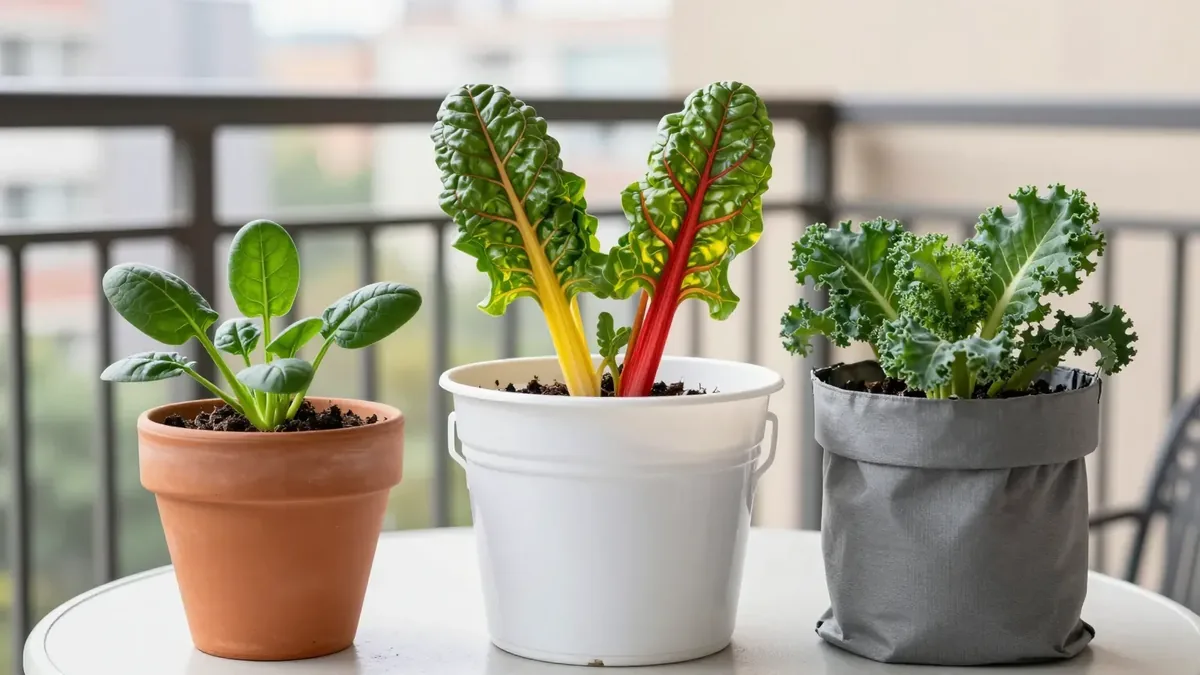
How Many Spinach, Chard and Kale Plants per Container? Counts by Pot Size
Quick answer: A 12-inch pot (about 3 gallons) holds 4 spinach plants, 2 Swiss chard plants or 1 kale plant. A 5-gallon bucket holds about the same. A 10-gallon grow bag holds 6 to 8 spinach, 4 chard or 2 kale. These counts are for full-size plants and are worked out from university extension spacing. You can plant closer if you pick the leaves young.
Spinach, Swiss chard and kale are all leafy greens for cool weather, but they don’t take up the same room. A spinach plant is small. A chard plant is a medium-sized clump. A kale plant is the biggest of the three. Put the same number of each in a pot and one of them will be crowded.
The counts below come from university extension guidance on container sizes and plant spacing. No extension service we found publishes one chart for all three crops in every pot size, so we worked the table out from their numbers and we say where they disagree. The byline explains extension advice. It is not a report of experiments on our own plants.
This post contains affiliate links, meaning we may earn a small commission at no extra cost to you. Full details are on our Affiliate Disclosure page.
In this guide: Counts at a glance | How we worked them out | Spinach | Swiss chard | Kale | Baby leaves | Mixing all three | Signs of crowding | Sowing and thinning | Harvesting | FAQ
Spinach, chard and kale plants per container, at a glance
| Container | Spinach | Swiss chard | Kale |
|---|---|---|---|
| 8-inch pot (about 1 gallon) | 2 | 1 | Baby leaves only |
| 10-inch pot (about 2 gallons) | 3 | 1 | 1 compact plant |
| 12-inch pot (about 3 gallons) | 4 | 2 | 1 |
| 5-gallon bucket | 4 | 2 | 1 |
| 10-gallon grow bag | 6 to 8 | 4 | 2 |
| 24-inch window box | 4 to 6 | 3 to 4 | 2 |
Depth matters as well as width. Colorado State University Extension lists a minimum depth of 8 inches for spinach and chard and 10 inches for kale, and Cornell Cooperative Extension lists 8 inches for all three. Many window boxes are shallower than that, so measure yours before planting chard or kale in it.
How we worked out the counts
Extension services give two kinds of numbers: a container size for each crop, and a distance between plants in a garden row. We used both.
- Container sizes. Iowa State University Extension lists a 1-gallon container for spinach, thinned to 3 inches apart, and a 1-gallon container for one Swiss chard plant. Texas A&M AgriLife Extension lists 2 spinach plants for a 1-gallon container. Cornell Cooperative Extension lists one chard plant or one kale plant per 2-gallon pot. Colorado State University Extension lists 5 gallons per plant for kale.
- Bigger containers. A handout from NC State Extension Master Gardener volunteers in Guilford County lists 6 to 8 spinach plants for a 10-gallon container and 2 to 4 chard plants for a 5 to 10 gallon container, both spaced 6 inches apart.
- Garden spacing. University of Minnesota Extension thins spinach to 2 to 4 inches, Swiss chard to 4 to 6 inches and kale to 8 to 12 inches. Penn State Extension says spinach needs 4 to 6 inches. Utah State University Extension spaces chard 6 inches apart and kale 12 inches apart.
- Pot size to gallons. Iowa State University Extension gives approximate volumes: an 8-inch pot holds about 1 gallon, a 10-inch pot 2 gallons, a 12-inch pot 3 gallons and a 14-inch pot 5 gallons.
The sources don’t always agree. For kale, Cornell lists one plant per 2-gallon pot, and Colorado State’s minimum is 5 gallons per plant with a minimum spacing of 18 inches by 18 inches per plant. For chard, Iowa State and Illinois list one plant for a 1-gallon container and Cornell lists one plant per 2-gallon pot. For spinach in a 1-gallon container, University of Illinois Extension says to thin to 1 to 2 inches apart and Iowa State says 3 inches. Our reading: use the wider spacing if you want full-size plants, and the closer spacing only if you plan to pick the leaves small.
How many spinach plants per pot
Spinach is the smallest of the three. University of Maryland Extension spaces it 3 inches apart to start, then thins to about 6 inches by cutting out every other plant. Our reading: about 6 inches between plants is the number to plan around for full-size spinach in a pot.
- 8-inch pot: 2 plants. This matches the Texas A&M figure of 2 plants for a 1-gallon container.
- 10-inch pot: 3 plants, set in a triangle.
- 12-inch pot or 5-gallon bucket: 4 plants, set in a square about 6 inches apart. A bucket is deeper than a 12-inch pot but about as wide across the top, so it doesn’t hold more spinach. If you’re using a bucket, check that it’s safe for growing food first.
- 10-gallon grow bag: 6 to 8 plants, the range in the Guilford County handout.
- 24-inch window box: 4 to 6 plants in a single row.
Don’t skip the thinning. Penn State Extension says that failing to thin spinach seedlings can result in stunted growth and premature bolting, which is when the plant sends up a flower stalk. Our guide to growing spinach on a balcony in fall covers varieties, sowing and timing.
How many Swiss chard plants per pot
Chard needs more room than spinach. Both Iowa State University Extension and University of Illinois Extension list one Swiss chard plant for a 1-gallon container, and Cornell Cooperative Extension lists one plant per 2-gallon pot. In a wider container, Colorado State University Extension says to space chard 6 inches or more apart. For garden rows, University of Maryland Extension says 8 to 12 inches for larger plants.
- 8-inch or 10-inch pot: 1 plant.
- 12-inch pot or 5-gallon bucket: 2 plants, about 6 inches apart. In a 12-inch pot (about 3 gallons) that is tighter than Cornell’s one plant per 2-gallon pot.
- 10-gallon grow bag: 4 plants. The Guilford County handout lists 2 to 4 for a 5 to 10 gallon container.
- 24-inch window box: 3 to 4 plants in a row, if the box is at least 8 inches deep.
Chard has one advantage over spinach in a pot. University of Minnesota Extension says spinach is sensitive to day length, bolting as the days get longer, while chard is not. A pot of chard can keep producing after a pot of spinach has gone to seed.
How many kale plants per container
Kale is the big one. University of Minnesota Extension thins it to 8 to 12 inches apart and Utah State University Extension spaces it 12 inches apart. For containers, the two sources we found are far apart: Cornell Cooperative Extension lists one plant per 2-gallon pot, at least 8 inches deep, and Colorado State University Extension lists 5 gallons per plant, at least 10 inches deep.
- 8-inch pot: too small for a full-size plant. Use it for baby leaves (see below).
- 10-inch pot: 1 plant. Our reading: choose a compact variety here. Cornell’s container list names a dwarf kale, Showbor, alongside Lacinato.
- 12-inch pot or 5-gallon bucket: 1 plant. A 5-gallon bucket meets the Colorado State minimum container size.
- 10-gallon grow bag: 2 plants, which is 5 gallons each. That meets Colorado State’s volume figure but not the 18 inches by 18 inches of spacing per plant in the same table.
- 24-inch window box: 2 plants, about 12 inches apart, if the box is at least 8 inches deep. That follows Cornell’s depth figure and the Minnesota and Utah State spacing. It is below Colorado State’s minimums for kale (10 inches deep, 5 gallons per plant, 18 inches between plants).
Colorado State University Extension calls kale and its relatives heavy feeders that need a steady supply of water, and says they develop a strong flavor if the soil gets dry. Our reading: that is the case for the bigger pot when you have the room. Kale belongs to the same family as broccoli, so our guide to what is eating your broccoli leaves shows how to tell caterpillar, aphid and slug damage apart, and our guide to keeping bugs off container vegetables covers netting.
The baby-leaf exception
All the counts above are for full-size plants. If you plan to pick the leaves small, you can plant closer. University of Minnesota Extension says closer spacing gives smaller “baby leaf” plants and wider spacing gives larger ones.
- Spinach: University of Illinois Extension says closer spacing, with no thinning, is satisfactory when you harvest the entire plants.
- Kale: University of Minnesota Extension says to space plants as close as 4 inches apart if you plan to harvest baby leaves only. University of Maryland Extension says 2 to 4 inches gives a larger number of small plants that can be harvested repeatedly.
- Chard: University of Maryland Extension thins chard to 4 inches apart when the plants are about 2 inches high, and says young leaves under 4 inches can be eaten fresh in salads.
Our reading: a pot sown this closely is a pot for salad leaves. The plants won’t reach full size unless you thin them to the counts in the table.
Can you mix spinach, chard and kale in one container?
Yes. A greens-garden project from Washington State University Extension in Snohomish County plants lettuce, spinach and a choice of kale, chard or mustard together in one large container or window box, and says that in containers you can reduce in-ground spacing by half or more.
Our reading: use the table to share out the space. In a 10-gallon grow bag, one kale plant takes about half the bag, one chard plant about a quarter, and one spinach plant about a seventh. One kale, one chard and two spinach plants would fill it.
Signs you’ve planted too many
- Small leaves that never size up. Closer spacing gives smaller plants, as the University of Minnesota Extension note above says.
- Spinach that bolts early. Penn State Extension lists premature bolting and stunted growth as results of not thinning.
- Kale that stalls. West Virginia University Extension says that not allowing enough space between kale plants will prevent root growth.
The fix is the same in each case: cut out the extra plants at soil level and eat them. Our guide to how many basil plants fit in one pot covers the same problem for herbs.
Sowing and thinning
- Sow shallowly. University of Minnesota Extension says to plant spinach, chard and kale seeds one-fourth to one-half inch deep.
- Expect extra chard seedlings. University of Maryland Extension says a Swiss chard seed is really a seed ball with several embryos, so you will need to thin unless the packet says the seed is monogerm.
- Thin early. Penn State Extension says to thin spinach as the plants reach 2 inches in height, and University of Maryland Extension says the same height for chard.
- Eat the thinnings. University of Maryland Extension calls thinned leafy greens your first harvest.
Use bagged potting mix, not garden soil. The Espoma potting mix on our gear page is the one we point beginners to, and the 10-gallon fabric grow bags we list there are the size used in the table. For timing, our planting planner shows what you can sow this month where you live, and our guides to watering and soil and fertilizer cover the care. Recommended Gear lists the pots we point beginners to.
Harvesting so the pot keeps producing
- Spinach: Penn State Extension says to snip off the outer leaves at their base and leave the main stem or rosette to keep growing.
- Chard: North Dakota State University Extension says to cut the outer leaves cleanly with a knife, and that taking no more than one-third of the leaves at a time keeps the plant producing.
- Kale: Utah State University Extension says older leaves are generally stripped off first, which lets the young leaves keep growing. It also says frosts help improve the flavor of a fall crop.
Want a nudge on what to grow indoors this winter? Get our free Fall & Winter growing calendar.
FAQ
How many spinach plants can I grow in a 5-gallon bucket?
About 4 full-size plants, spaced roughly 6 inches apart. Penn State Extension says spinach needs 4 to 6 inches of space, and a bucket is about as wide across the top as a 12-inch pot. You can fit more if you pick the leaves young.
How many kale plants can I grow in a 5-gallon bucket?
One. Colorado State University Extension lists 5 gallons per plant for kale, in a container at least 10 inches deep. Cornell Cooperative Extension lists one plant per 2-gallon pot.
How many Swiss chard plants fit in a 5-gallon bucket or grow bag?
Two is our count. A handout from NC State Extension Master Gardener volunteers in Guilford County lists 2 to 4 chard plants for a 5 to 10 gallon container, spaced 6 inches apart.
How many spinach or kale plants fit in a 10-gallon grow bag?
6 to 8 spinach plants, the range the Guilford County handout lists for a 10-gallon container, or 2 kale plants at Colorado State University Extension’s 5 gallons per plant, though the same table also lists a minimum spacing of 18 inches by 18 inches per plant, which a 10-gallon bag does not give two plants.
How deep should a container be for spinach, chard and kale?
Colorado State University Extension lists a minimum depth of 8 inches for spinach and chard and 10 inches for kale. Cornell Cooperative Extension lists 8 inches for all three.
How many Swiss chard seeds should I plant per hole?
Our tip: one or two. University of Maryland Extension says a chard seed is a seed ball with several embryos, so one seed can give several seedlings. Thin to one plant per spot when they are about 2 inches high.
Sources we checked
- Container Vegetable Gardening (PM 870B). Iowa State University Extension (PDF)
- Growing Vegetables in Containers. University of Illinois Extension
- Spinach. University of Illinois Extension
- Vegetable Gardening in Containers (HORT-PU-090). Texas A&M AgriLife Extension (PDF)
- Vegetable and Herb Gardening in Containers. Cornell Cooperative Extension (PDF, 2016)
- Vegetable Gardening in Containers. Colorado State University Extension
- Container Vegetables: Guide to Pot Sizes (Container Edibles handout). NC State Extension Master Gardener volunteers, Guilford County (PDF, 2021; archived copy)
- Growing spinach and Swiss chard in home gardens. University of Minnesota Extension
- Growing collards and kale in home gardens. University of Minnesota Extension
- Spinach. University of Maryland Extension
- Swiss Chard. University of Maryland Extension
- Growing Leafy Greens in a Home Garden. University of Maryland Extension
- Growing Spinach, a Cool-Season Vegetable. Penn State Extension
- How to Grow Swiss Chard in Your Garden. Utah State University Extension
- How to Grow Kale in Your Garden. Utah State University Extension
- From Garden to Table: Leafy Greens! (H1754). North Dakota State University Extension (PDF)
- Greens Garden. Washington State University Extension, Snohomish County (archived copy)
- Growing Kale in West Virginia. West Virginia University Extension