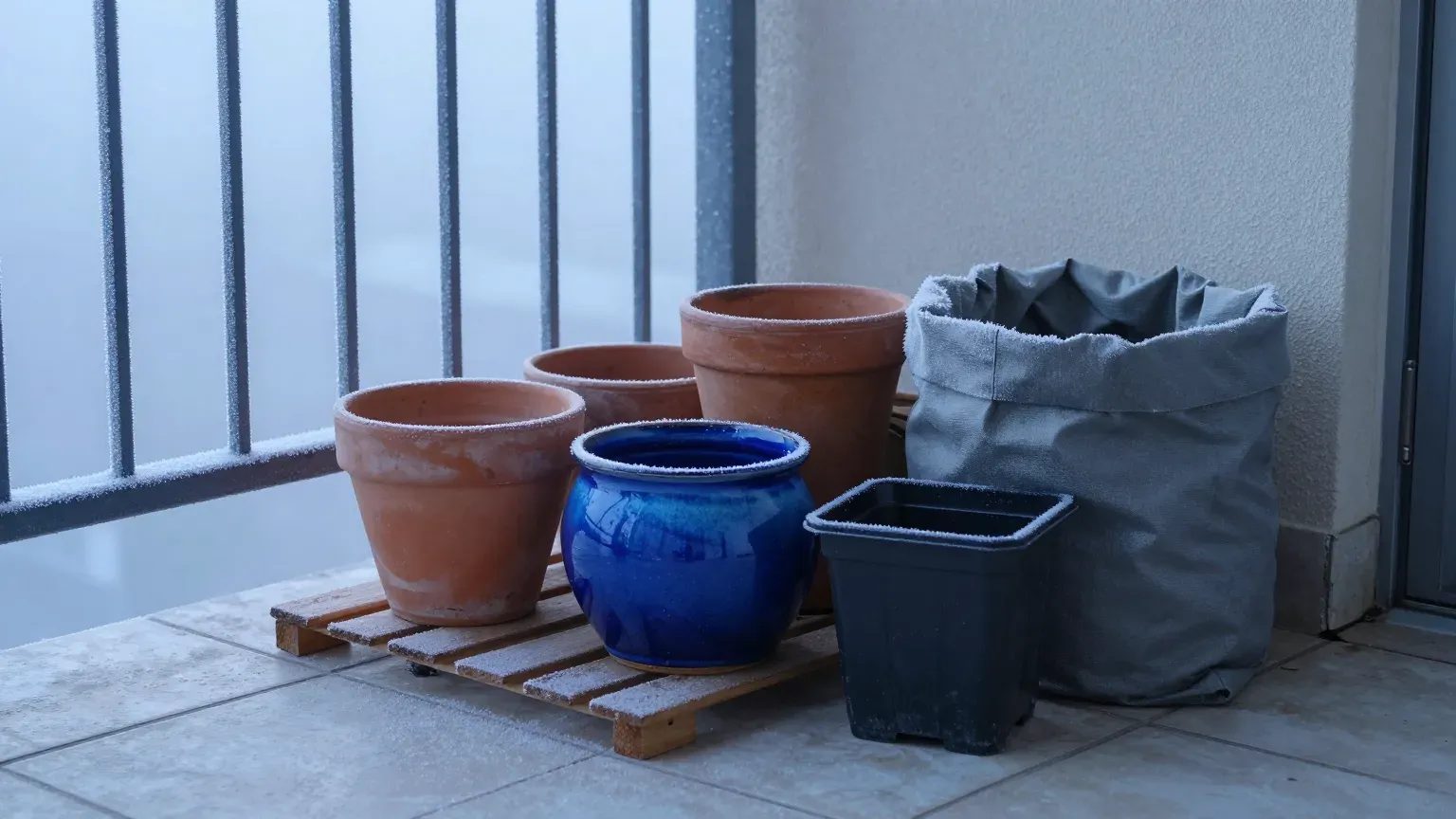
Can You Leave Vegetable Pots Outside in Winter?
Quick answer: Some pots can and some shouldn’t. Large wooden, concrete, fiberglass and resin planters can usually stay out, and flexible plastic pots generally cope. Fabric grow bags are untested: the maker says some gardeners leave them out, but the cautious move is to empty, dry and fold them away. Terracotta, unglazed clay and glazed ceramic pots can crack in freeze-thaw weather, so empty them and store them dry. If plants are still growing in a pot, their roots can get as cold as the air: water before the soil freezes, then group and insulate the pots or move them to an unheated garage.
When the first cold nights arrive, every pot on your balcony or patio raises the same question: drag it inside, or leave it where it is? The answer depends on what the pot is made of and whether anything is still growing in it.
Below we go material by material, then cover the old soil and any plants you hope to keep. Everything comes from US university extension services and the Chicago Botanic Garden (named as we go), plus a few clearly labelled UK and manufacturer sources where extension advice runs out.
This post contains affiliate links, meaning we may earn a small commission at no extra cost to you. Full details are on our Affiliate Disclosure page.
In this guide: Why pots crack · Which pots can stay out · Emptying pots and old soil · Pots with plants in them · Pre-frost checklist · FAQ
Why pots crack in winter (and why roots in pots get colder)
Two different things can go wrong with a container over winter: the pot can break, and the roots inside it can freeze.
The pot. Unglazed clay soaks up water. When that water freezes it expands, and repeated freezing and thawing can crack the pot. “Water freezes, expands and cracks clay pots,” as University of Maine Extension horticulturist Kate Garland puts it.
The roots. Soil in the ground insulates roots; a pot above ground doesn’t. Penn State Extension says the roots of above-ground container plants “can be the same temperature as the winter air,” and both UMass and Iowa State Extension note that roots are far less cold-hardy than the top of the plant. Extension data for ornamental shrubs and perennials show some roots are badly injured at around 20–28°F, much warmer than the cold the same plants’ tops can take. We found no equivalent figures for vegetables, but it’s why Penn State and Illinois Extension both say to “go two zones colder” for plants in pots.
Which pots can stay outside in winter?
The short version (“stay out” means the pot itself; tender vegetables won’t survive frost in any pot):
| Pot | Stay out? | Main risk | Best move |
|---|---|---|---|
| Terracotta / clay | Better not | Soaks water, cracks | Empty, store dry |
| Glazed ceramic | Better not | May crack | Empty, store under cover |
| Plastic | Usually yes | Old pots go brittle | Retire stiff, faded pots |
| Fabric grow bag | Untested | Roots get colder | Empty, dry, fold |
| Large concrete | Usually yes | Too heavy to move | Leave in place |
| Metal | Usually yes | Roots swing hot/cold | Keep drainage clear |
| Wood | Usually yes | Rot if unprotected | Rot-resistant, sealed wood |
| Fiberglass / resin | Usually yes | Stiff types go brittle | Leave in place |
Terracotta and unglazed clay: bring them in
“The more porous the material like terra cotta the more likely it will absorb water and crack in the event of a hard freeze,” says University of Georgia Extension, and University of Nevada, Reno Extension calls clay “more easily damaged by freezing and thawing.” Garland’s advice is simple: store clay pots indoors.
Can’t bring a big one in off a rental balcony? Keep it as dry as you can. Tim Johnson, director of horticulture at the Chicago Botanic Garden, suggests a garage or shed out of the rain, or, if pots must stay outside, storing them upside down under a tarp.
Sold as “frost-proof”? The UK’s Royal Horticultural Society (RHS) mentions frost-proof terracotta, and Iowa State Extension notes clay fired longer and hotter ends up harder. We found no US extension standard for the label, so treat it as the maker’s claim and keep the pot dry anyway.
Glazed ceramic: treat it like clay
A glaze looks weatherproof, but extension services don’t give it a pass. Penn State says “it’s best not to leave clay, ceramic, or glazed pottery pots exposed to the elements since they may crack,” and Nebraska and Vermont Extension give the same warning for ceramic pots. Empty, clean and store them under cover; if one is too heavy to move, keep it dry as above.
Plastic: usually fine, but old stiff pots can crack
Most plastic pots can stay out. The weak spots are sunlight and age. Illinois Extension notes that pots left in the sun, “especially plastics,” can become brittle and break down over time, and University of Nevada, Reno Extension advises avoiding stiff pots because they “become brittle with cold and age.” Iowa State Extension says UV inhibitors help protect pots from fading and going brittle, and if a label recommends outdoor use, the pot probably has that treatment.
So flexible pots generally ride out winter; an old, faded or stiff one is the likeliest to crack. Penn State also says plastic and metal pots need “plenty of drainage holes to survive the winter without damage,” so check the holes aren’t blocked.
Fabric grow bags: the real issue is the roots
We found no extension research on whether freezing harms the fabric itself. Smart Pots, a grow bag manufacturer (so read this as the maker’s view), says some gardeners leave their bags outside, and that its bags “are meant to hold their shape and last for many years.”
The bigger issue is the roots, because a thin fabric wall can’t offer much insulation. A small 2006 University of New Hampshire study of four shrub species (republished on the Smart Pots website) found the soil in fabric pots was up to about 10°F colder than in plastic pots on below-zero nights, although the shrubs’ roots in fabric still survived or regrew at least as well. Shrubs aren’t vegetables, so treat that as a hint.
Most grow-bag vegetables are finished by winter anyway, so the cautious option is to follow Smart Pots’ storage steps: scoop out the soil, let the bag dry completely, then fold it and store it somewhere clean and dry. A stack of folded bags fits in a closet, a real perk on a balcony.
Concrete and cement: big planters can stay
Penn State says “very large wooden or concrete planters can usually be left in place,” and Nebraska Extension lists concrete among the more weather-resistant materials. Handy, since they’re the hardest pots to move. We found no guidance on small, thin cement pots, so if yours are light enough to lift, emptying them and keeping them dry is the cautious choice.
Metal, wood, fiberglass and resin
Metal: the pot itself is strong, but University of Nevada, Reno Extension notes that metal conducts heat and cold, “exposing roots to rapid temperature fluctuations.” Fine for an empty pot, harder on roots.
Wood: UNR Extension says wood “protects roots from rapid temperature changes,” and Penn State says very large wooden planters can usually stay put. Choose rot-resistant wood and protect it with paint or a preservative.
Fiberglass and resin: Nebraska Extension counts both as more weather resistant, and the RHS (UK) lists fiberglass among its frost-proof choices. UNR’s warning about stiff pots going brittle “with cold and age” covers fiberglass as well as plastic.
Should you empty pots for winter? Leaving soil in pots
Start with the plants. Most summer vegetables are done once frost arrives. South Dakota State Extension notes that tomatoes can’t tolerate frost, and that beans, peppers, eggplant, cucumbers, summer squash and melons should be protected or harvested before even a light frost. Pull spent plants, main roots and all (University of Wisconsin–Madison Extension), and bag and bin badly diseased tomato, potato or pumpkin plants.
Then the soil. Leaving mix in a pot over winter is mainly a risk to the pot, not the mix. “It’s not necessarily a concern for the potting mix, it’s a concern for the containers,” says Garland. Illinois Extension recommends removing the growing mix and storing pots upside down or somewhere protected. That matters most for clay and ceramic. Empty pots are also lighter and stack away more easily on a small balcony, and it’s a good moment to check drainage holes (see our pot size and drainage guide).
Can you reuse the old mix? Usually, if the plants were healthy:
- Refresh it. For larger containers, Oklahoma State Extension suggests replacing the top 6 inches or so with new mix. University of Maryland Extension suggests mixing in compost or fresh potting mix (up to 50% by volume) and feeding new plants regularly, because old mix will be low in nutrients.
- Start fresh after disease. Oklahoma State, Maryland and Maine Extension all advise against reusing mix from plants that had disease problems, and Maryland doesn’t recommend trying to sterilize it.
- Small pots: Garland suggests composting the soil from small and medium pots and starting over.
- Clean before reuse: Cornell’s container guide suggests disinfecting pots with a 10% bleach solution.
Cornell’s guide goes further and says to replace container mix each season, but “refresh healthy mix, replace diseased mix” is where most advice lands. No compost pile or garden bed? Mix from healthy plants can wait in a lidded bin until spring.
Pots with plants still in them: keeping roots alive
What’s worth keeping outside? Garlic is the classic. Cornell’s container guide has you plant it in October and harvest the following July, and Ask Extension, answering a Seattle gardener (a mild climate), suggests 1–2 inches of straw or leaf mulch over winter and less watering until spring; in colder areas, add the protection steps below (more in our garlic in containers guide). Hardy perennial herbs such as chives, thyme, oregano, sage and mint can come through too, but apply the two-zones-colder rule, since hardiness ratings are for plants in the ground. Rosemary is a tender perennial in cold climates; Illinois Extension says to overwinter it indoors (see bringing your container garden indoors and overwintering herbs before first frost). University of Maine Extension is candid: “There is never a guarantee with overwintering herbs outdoors in pots.”
Cold-tolerant crops like kale can take moderate freezes of 24–28°F, according to South Dakota State Extension, which stretches the fall harvest (see our best fall and winter vegetables for containers). That’s not the same as surviving a whole cold-zone winter in a pot.
For anything you leave outside:
- Water before the soil freezes. Dry soil freezes faster than moist soil (Penn State), and moist mix releases heat that protects roots (UMass Extension). Don’t overwater, though: Penn State warns of root rot.
- Group the pots. Cluster them in a sheltered spot, with larger pots on the outside and smaller ones in the middle (Colorado State Extension). Nebraska Extension and Colorado State suggest the north or east side of the house; Nebraska says that means fewer freeze-thaw cycles.
- Insulate. Penn State suggests wrapping pots in bubble wrap or other insulating material. University of Maine Extension suggests 2–3 inches of mulch in each pot. If you have room, Colorado State suggests mulching heavily with straw, leaves, hay or shredded bark around and over a cluster.
- Lift pots off hard surfaces. Nebraska Extension warns that ice can form under a pot sitting on a hard surface and keep the soil constantly soggy; a few wood slats are enough to raise it. Cornell suggests a piece of wood or stone, and the UK’s RHS suggests pot feet or bricks. If you’d rather not cut slats, a pack of pot feet does the same job. Tip out any saucer so water can’t sit and freeze; University of Georgia Extension warns that water pooling in pots can freeze and damage the roots or the pot.
- Bury the pot, if you have ground. Penn State and Iowa State suggest sinking the pot into the soil, which insulates the roots. Not an option on most balconies, so renters usually rely on the next step.
- Move it under cover. Penn State lists an unheated garage, shed, cold frame or basement. Iowa State aims for a moderately cold spot of about 20–45°F and notes that unheated buildings swing in temperature, so check on your plants. Colorado State says to check soil moisture often. Our guide to growing in your garage covers the space itself.
Covering plants on a single frosty night is a different job. Our frost protection guide for containers covers when and how to use covers such as this frost cloth.
How to winterize outdoor pots before first frost: a checklist
- Look up your area’s average first-frost date.
- Harvest or pull tender vegetables; bin diseased plants.
- Empty, clean and store terracotta, clay and glazed ceramic pots somewhere dry.
- Empty, dry and fold grow bags.
- Check plastic pots; retire faded, stiff ones.
- Clear drainage holes and tip out saucers.
- Water any keeper plants well before the soil freezes.
- Group, insulate and raise keeper pots, or move them to an unheated garage or shed.
- Hanging baskets too? Use our pre-frost checklist for hanging planters.
Not ready to call it a season? Our What Can I Plant Now? planner shows what’s still worth sowing.
Want a nudge when it’s time to winterize? Get our free Fall & Winter growing calendar.
Frequently asked questions
What pots can stay outside in winter?
Large wooden, concrete, fiberglass and resin planters can usually stay out, and flexible plastic pots generally cope. Fabric grow bags haven’t been tested over winter; the maker says some gardeners leave them out, but they’re easy to empty, dry and fold away. Terracotta, unglazed clay and glazed ceramic pots are the ones extension services suggest emptying and storing under cover, because they can crack in freeze-thaw weather.
Can I leave soil in pots over winter?
You can, but it mainly puts the pot at risk, not the soil. Extension advice is to empty pots before winter, especially clay and ceramic ones. If the plants were healthy, refresh the old mix with compost or fresh potting mix in spring. If they had disease, start with fresh mix.
Will plastic pots crack in winter?
Flexible plastic pots usually come through fine. Old pots that sunlight has made brittle, and stiff pots, are the ones most likely to crack. Pots labelled for outdoor use usually have UV protection.
Can you leave terracotta pots outside if they’re empty?
It is better to store them in a garage or shed, out of the rain. If they must stay outside, turn them upside down and cover them with a tarp so they stay as dry as possible.
Can you leave grow bags out all winter?
We found no research on what freezing does to the fabric itself; the maker, Smart Pots, says some gardeners leave them out. Roots in fabric can get colder than roots in plastic pots, so once your vegetables are finished, the simplest option is to scoop out the soil, let the bag dry completely, then fold it and store it.
Should I put my pots in the garage for winter?
An unheated garage is a good spot for hardy plants in pots and for empty clay pots. Iowa State Extension suggests a spot that stays roughly between 20 and 45 degrees F, but unheated garages can swing warmer and colder, so check on plants and their soil moisture regularly.
Do pots need watering in winter?
Water hardy plants well before the soil freezes, because moist soil freezes more slowly than dry soil. After that, water only when the soil is dry, and don’t overwater, which can cause root rot.
Sources we checked
- Penn State Extension, Overwintering Plants in Containers (updated Oct 2026)
- Penn State Extension, Winter Outdoor Arrangements
- University of Maine Extension (Kate Garland), quoted in Bangor Daily News: Can you reuse potting soil? (2019)
- University of Maine Extension, How do you prepare potted perennial herbs for winter outside? (2022)
- University of Georgia Extension, Newton County, Winter Potted Plant Care (2020)
- University of Nevada, Reno Extension, Container Gardening, Fact Sheet FS-00-42 (PDF)
- Iowa State Extension, How to Select Quality Plant Containers (reviewed 2024)
- Iowa State Extension, Overwintering Unplanted Trees, Shrubs and Perennials (reviewed 2025) and How can I over-winter container-grown trees and shrubs?
- University of Illinois Extension, Gardenbite: Tips for overwintering potted perennials (2025), Overwintering perennial patio containers (2014) and Perennial herbs (2023)
- UMass Extension, Overwintering Containerized Perennials and Overwintering Container-Grown Ornamentals (2024)
- Nebraska Extension, Yard and Garden column on container gardening (PDF) (2017)
- UVM Extension, Putting the garden to bed (2022)
- Colorado State Extension PlantTalk, Overwintering Container Plants
- Cornell Cooperative Extension, Vegetable and Herb Gardening in Containers (PDF) (2016)
- Chicago Botanic Garden (Tim Johnson), quoted in Daily Herald: Terra-cotta pots absorb water that can freeze (2021)
- South Dakota State Extension, Fall Frost Tolerance of Common Vegetables (2023)
- University of Wisconsin–Madison Extension, Putting your garden to bed for winter (2019)
- Oklahoma State Extension, Gardeners can reuse, recycle last year’s potting soil (2023)
- University of Maryland Extension via Ask Extension, Reusing potting mix (2026)
- Ask Extension, Growing garlic in a container (Seattle question) (2025)
- University of Minnesota Extension, Growing herbs in home gardens
- Smart Pots (manufacturer source), How to take care of your Smart Pots through winter and University of New Hampshire shrub study (hosted by Smart Pots)
- Royal Horticultural Society (UK source), Containers: Winter Planting Ideas