How to Grow Vegetables in Your Garage (Even With No Windows)
A garage is the most underused growing space most people have. It’s dark and it’s cold, and both of those are fixable — and in exchange you get things a living room or a balcony will never give you: a floor that doesn’t mind water, a wall you can put a shelf against, a power outlet, often a tap, and somewhere to run a bright grow light 16 hours a day without anyone having to live next to it. Whether it’s a single-car garage on a townhouse, a rented bay you share with a lawnmower, or the storage end of a carport, the same rules apply.
This guide is about growing vegetables in a garage for real — greens through winter, seedlings in spring, and with a bit more kit, tomatoes and peppers in a spot that never sees the sun. It assumes no experience and no complicated setup. If you can find the outlet and read a thermometer, you can do this.
This post contains affiliate links, meaning we may earn a small commission at no extra cost to you — full details are on our Affiliate Disclosure page.
Quick answer: Yes, you can grow vegetables in a garage, even with no windows, as long as you add a grow light. Measure the overnight low for a week first: below 35°F is storage only, 45–60°F grows lettuce, spinach, microgreens and herbs well, and 60°F or more lets you try dwarf tomatoes and peppers. Get pots off the cold concrete, run LED lights 14–16 hours a day on a timer, add a small fan, and never run the car with the door closed.
In this guide: Pros and cons · Measure first · Light · Temperature · Air · Water · What to grow · Setups · Safety · Mistakes · FAQ
What a Garage Gives You — and What It Doesn’t
Start with the good news. Compared with growing indoors, a garage has:
- A floor built for mess. Concrete shrugs off spilled potting mix and overflowing pots. You can water generously without a towel underneath everything.
- Room. Even a crowded single-car garage usually has a 4-foot stretch of wall going spare — enough for a shelf of greens or a small grow tent.
- Power and, often, water. Most garages have at least one outlet, and many have a tap or a utility sink. That’s the whole infrastructure an indoor garden needs.
- Distance from the living space. Grow lights are bright, fans hum, and soil attracts the odd fungus gnat. In a garage, none of that is in your bedroom.
- Cool, steady temperatures in spring and fall. The shoulder seasons in a garage are close to ideal for lettuce, spinach, and seedlings — cooler than the house, warmer than outside.
Now the three things a garage doesn’t give you, each of which gets its own section below: light (garages are dark, even the ones with a window), the right temperature (cold in winter, an oven in summer), and moving air. And it comes with a car, which brings its own rules — see the safety section before you set anything up.
Step One: Measure Before You Plant
Every garage is different, and the only way to know what yours will grow is to measure it. Put a small digital thermometer/hygrometer where the plants will go — at shelf height, not on the floor — and check it for a week: first thing in the morning for the low, and mid-afternoon for the high. Two patterns matter:
- Attached garages that share a wall with a heated house usually sit somewhere between the house temperature and the outdoor one — often above freezing on a cold night in a mild climate, but well below it in a real cold snap.
- Detached garages track the outside temperature closely. If it’s 20°F outside overnight, it’s not far off that inside.
Once you have a week of readings, here’s roughly what they mean for vegetables:
| Overnight low in the garage | What it’s good for |
|---|---|
| Below 35°F | Storage only — dormant potted plants, garlic in containers, stored roots. Nothing actively growing without heat. |
| 35–45°F | Hardy greens under lights — kale, spinach, mâche, some lettuces — but slowly. A small tent to hold the light’s warmth makes a big difference here. |
| 45–60°F | All the leafy crops, microgreens, scallions, radishes, and herbs grow well under lights. Seed-starting works with a heat mat under the trays. |
| 60–75°F | Everything, including dwarf tomatoes, peppers, and bush beans, given enough light. |
| Above 85°F by day (summer) | Too hot for most vegetables unless you can ventilate. Grow outside in summer and use the garage in the cold months. |
Light: The One Thing You Can’t Skip
A garage window, a row of glass panes in the door, or leaving the door open for a few hours does not grow vegetables. Even a spot that looks bright to you is getting a small fraction of the light a plant needs, and the result is the same every time: seedlings that stretch and flop, lettuce that stays thin and pale, a tomato that grows leaves and never flowers. Plan on a grow light from day one, and think of any window light as a bonus.
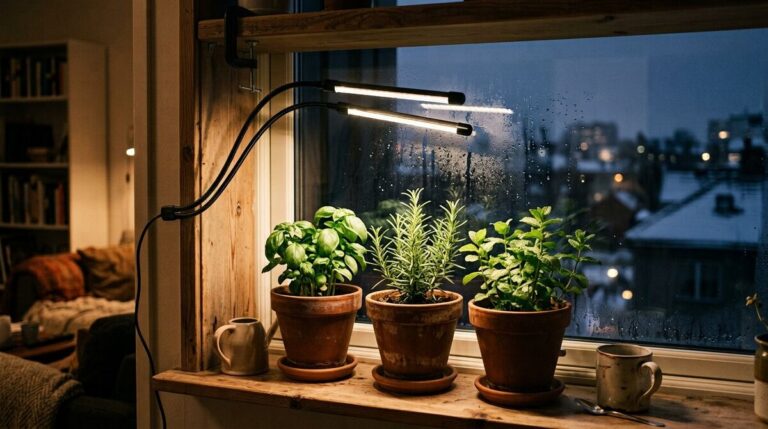
- For a few pots of greens or herbs: a clip-on grow light with a built-in timer, like the GooingTop clip-on we recommend for windowsill herbs, clamped to a shelf edge over the pots. Our grow lights for small-space herbs guide covers what to look for.
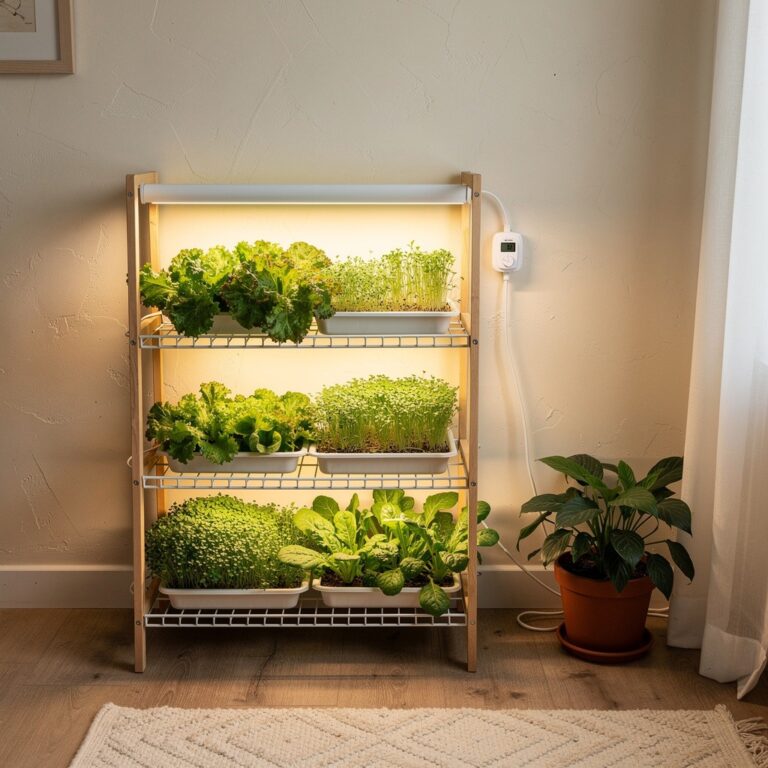
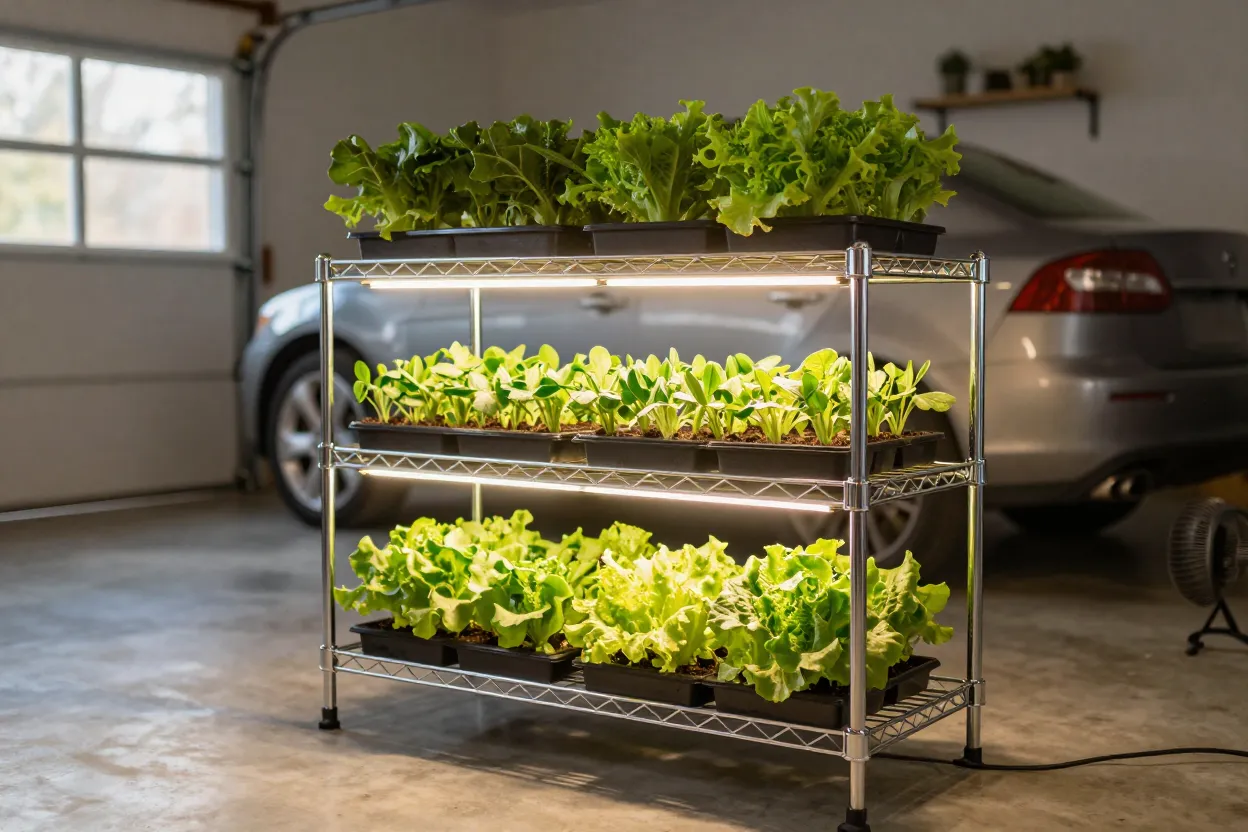
- For a shelf of lettuce, spinach, and microgreens: LED strip lights mounted under each shelf of a wire rack, 6–12 inches above the leaves. Our best grow lights for indoor vegetables guide compares the options. This is the classic garage setup — one rack, two or three lit shelves, and a timer.
- For tomatoes and peppers: a 100-watt-class LED panel hung over the plants, ideally inside a small grow tent. Our grow tents for vegetables guide covers that combination.
- Hours: 14–16 a day for greens, 16 for fruiting crops, with a dark period every night. Put the light on a plug-in outlet timer and it takes care of itself — in a garage you won’t walk past twice a day to notice it’s off.
- Bounce it back. Garages are usually gray and dark. A sheet of white foam board or a cheap reflective panel behind and beside the shelf sends a surprising amount of light back at the plants for nothing.
Temperature: Keeping the Cold Off the Roots
Vegetables tolerate cool air far better than they tolerate cold roots, and in a garage the cold comes up from the floor. A concrete slab in January is often noticeably colder than the air a few feet above it, and a pot sitting on it is a pot with a cold root ball that won’t take up water properly. A few things fix most of it:
- Get the pots off the slab. A wire shelving rack, a wooden pallet, or a sheet of rigid foam insulation under the pots is the single most effective thing you can do in a cold garage. Bottom shelf up, not floor.
- Use the light’s warmth. A grow light running 16 hours a day makes heat. Inside a small grow tent that heat stays around the plants instead of drifting off into the garage; on an open shelf, a sheet of clear plastic draped over the front of the rack at night does a rough version of the same thing.
- Warm the seeds, not the room. Trying to heat a garage is expensive and rarely works. A seedling heat mat under the trays warms the only thing that needs warming — the soil — for the cost of running a light bulb. Oregon State Extension puts the best germination soil temperature at around 85°F for tomatoes and peppers and about 70–75°F for spinach and lettuce, whatever the air is doing. If you do add heat to the space, use an electric heater: unvented propane or kerosene heaters give off carbon monoxide and ethylene, and ethylene damages tomatoes and other vegetables (Alabama Extension).
- On the worst nights, cover. If a cold snap is forecast to take the garage below freezing, drape frost cloth over the shelf or tent exactly as you would over pots on a balcony. Our frost protection for containers guide covers the same approach outdoors.
- Keep the door shut. Opening a garage door on a freezing morning dumps all the stored warmth in about a minute. If the car goes out at 7 a.m. every day, put the plants at the far end of the garage, away from the door, and consider a tent.
Summer is the opposite problem. A garage with the door facing the afternoon sun can go well past 100°F inside, and nothing edible enjoys that. In most of the US the sensible pattern is to grow in the garage from fall through spring and move everything out to the balcony, patio, or step for summer — or, if you’re set on year-round, run a fan through an open window and an exhaust vent and accept that July will be the hardest month.
Air and Humidity
Garages have still air, and still air is where seedlings damp off and where mold gets going on the surface of the potting mix. A small clip fan or a desk fan on low, pointed across the plants rather than straight at them, keeps leaves dry and stems sturdy — the plant equivalent of a breeze. Run it whenever the light is on.
Humidity in a garage swings with the weather. In winter it’s often dry, which means pots dry out faster than the cool air suggests; in a damp climate or after rain it can be soggy, which is when the fan matters most. The hygrometer you set up in step one tells you which you’re dealing with. Somewhere around 40–60% is comfortable for most vegetables; above 70% for days on end, move more air.
Water
Watering is easier in a garage than anywhere else in the house — a utility sink or a hose bib right there, a floor that forgives you, and no carpet to protect. Three things still matter. Keep a tray or saucer under every pot, because a slab that stays wet under a shelf for weeks grows its own mold. Let cold tap water sit in the can for an hour before using it in winter; icy water on a warm root ball checks growth. And check the soil with a finger rather than watering on a schedule — plants under a light in dry winter air can need water twice as often as you’d expect, while the same plants in a cool, damp garage might go a week. Our soil and fertilizer basics guide covers the potting mix side of this.
What to Grow in a Garage
- The sure things, under any light: microgreens, loose-leaf lettuce, spinach, arugula, baby kale, scallions, radishes, and herbs like parsley, chives, and cilantro. All of them are happy in cool air, harvested young, and forgiving of a modest light. Our microgreens without sunlight guide is the fastest first crop, and indoor winter vegetable gardening walks through the rest.
- With a proper panel and 60°F-plus: a dwarf tomato, compact peppers, bush beans, a bush cucumber on a short trellis. These want warmth and a lot of light, and in a garage that usually means a tent. Treat them as a winter project rather than a grocery replacement.
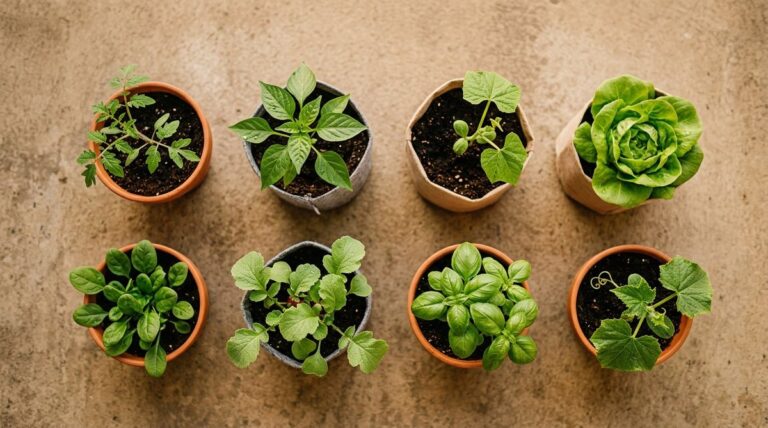
- Seedlings for spring: a garage shelf with strip lights and a heat mat is a better place to start tomatoes, peppers, and brassicas in February and March than any windowsill — cooler air keeps them stocky, and you can run trays by the dozen.
- The garage as a winter waiting room: a cold-but-not-freezing garage is exactly where potted strawberries, dormant perennial herbs, and garlic in containers like to spend the coldest weeks, out of the wind, with the pot not frozen solid. They don’t need light while dormant. Anything you want to keep growing, like rosemary or bay, needs a light — our guide to overwintering herbs explains which is which.
- Not worth it: full-size vining tomatoes, squash, corn, and anything that needs bees and a full summer. Wait for the balcony.
Two Simple Garage Setups
The shelf. A wire shelving rack against a wall, LED strip lights zip-tied under two or three shelves, a plug-in timer, a clip fan, and trays of greens and seedlings on each lit shelf. This is the cheapest working garage garden and the one most people should start with. It grows a steady supply of salad through winter and every seedling you’ll need in spring, and it packs flat if you move. Bottom shelf for supplies, not plants.
The tent. A 2×2 or 2×4 grow tent in a corner with a 100-watt-class LED panel, a small exhaust fan, and two or three pots of tomatoes, peppers, and greens. It costs more, but it solves the garage’s cold and dark in one move: the reflective walls make the light go further and hold its warmth, the tray catches the water, and the zipper keeps the car’s side of the garage separate from the plants’ side. Our grow tents for vegetables roundup covers the sizes and what fits in each.
Either way, use pots that are easy to move. Fabric grow bags with handles are ideal in a garage — light, forgiving of overwatering, and simple to carry outside when spring arrives.
Garage Safety: The Car, the Cords, and the Mice
- Never run the car in the garage with the door closed — for your sake far more than the plants’. Exhaust fumes are a carbon monoxide hazard to you, and the ethylene in them makes plants drop leaves and flowers (Alabama Extension lists engine exhaust as a main source of ethylene damage in vegetables). Start the car with the door open and pull straight out; keep the plants at the far end, away from the tailpipe.
- Move the fumes out. Gasoline cans, paint, solvents, and weed killer don’t belong in the same air as food you’ll eat. Store them in a sealed cabinet, or better, somewhere else.
- Treat the electrics with respect. Use one grounded, heavy-duty extension cord rated well above the wattage of everything plugged into it, run it where it won’t sit in water, and don’t chain power strips together. Newer US garages have GFCI-protected outlets; if yours trips, that’s a warning, not an obstacle to work around. Keep the timer and plugs above splash height, and water with the light off when you can.
- Assume mice. A garage is a mouse’s idea of a good time, and seedlings and seed packets are on the menu. Store seed in a sealed container, keep spilled mix swept up, and if you see droppings, deal with it before the seed trays go in.
- Keep the car’s path clear. Plants, cords, and trays stay out of the space the car needs, including the door swing. It sounds obvious until you back over a tray of lettuce.
- Don’t block the garage door or the house door, and keep anything electrical clear of the door’s tracks and opener.
Common Mistakes
- Relying on the window. The most common one. A garage window feels bright and grows nothing. Buy the light first.
- Pots straight on the concrete. Cold roots, wet slab, slow plants. A rack or a pallet fixes all three.
- Trying to heat the whole garage. Expensive and mostly wasted. Heat the soil (a mat), hold the light’s warmth (a tent or a plastic sheet), and choose crops that like it cool.
- Watering on a schedule. Garage conditions swing more than a living room’s. Check the soil, not the calendar.
- Forgetting the plants exist. Out of sight is out of mind. A timer for the light and a daily walk past the shelf are the whole management system — the walk is the part people skip.
- Growing through summer in an unventilated garage. The garden that thrived from October to April cooks in July. Move it out, or plan to.
Frequently Asked Questions
Can you grow vegetables in a garage with no windows?
Yes. A window adds very little light anyway, so a garage garden runs on grow lights. LED strips 6–12 inches above greens, or a 100-watt-class panel for tomatoes and peppers, on a timer for 14–16 hours a day, will grow vegetables in a completely dark garage.
How cold is too cold to grow vegetables in a garage?
If the garage drops below about 35°F at night, use it for storage and dormant plants only. Hardy greens like kale and spinach grow slowly at 35–45°F, most leafy crops do well at 45–60°F, and tomatoes and peppers need 60°F or more.
What vegetables grow best in a garage?
Microgreens, loose-leaf lettuce, spinach, arugula, baby kale, scallions, radishes and herbs like parsley and chives. They like cool air, are harvested young and do fine under modest LED lights. With a grow tent and a warmer garage you can add dwarf tomatoes, compact peppers and bush beans.
Is it safe to grow plants in a garage with a car?
Yes, with a few rules. Never run the car with the door closed, keep plants at the far end away from the tailpipe, store fuel and chemicals in a sealed cabinet, and keep plants, cords and trays out of the car’s path. Engine exhaust is a carbon monoxide hazard to you and releases ethylene that damages plants.
Do I need to heat my garage to grow vegetables?
Usually not. Heat the soil with a seedling mat, keep the light’s warmth around the plants with a small tent or a plastic sheet at night, and lift pots off the cold concrete. If you do add heat, use an electric heater rather than an unvented propane or kerosene one.
Sources we checked
- Oregon State University Extension: Soil Temperature Conditions for Vegetable Seed Germination
- Alabama Cooperative Extension: Greenhouse Vegetables and Ethylene Damage
- University of Maryland Extension: Growing Microgreens and Baby Greens Indoors
- University of Illinois Extension: Grow Herbs and Lettuce Indoors This Winter
- University of Minnesota Extension: Lighting for Indoor Plants and Starting Seeds
If you’re setting up for the cold months, our Fall Container Garden Guide maps the whole transition from balcony to indoors, and indoor winter vegetable gardening covers the crops that make it worthwhile. Ready to go beyond greens? The grow tents for vegetables guide picks the tent for your corner. New to growing food in a small space altogether? Start Here. And the grow bags, light, and frost cloth mentioned above are all on our Recommended Gear page.