
Best Grow Lights for Indoor Vegetables (5 Small-Space Picks)
A few herbs can muddle through winter on a bright, south-facing windowsill. Lettuce, spinach, and most other vegetables won’t. A tray of leafy greens needs 14–16 hours of strong light a day to grow well indoors — far more than a window delivers from November through February — and if you’ve ever watched a tray of indoor lettuce turn into pale, floppy stems that flop over the rim, you’ve seen what happens without it. A grow light fixes that. For a small apartment setup you need less than the product listings suggest, but more than the little clip-on that keeps a basil plant alive.
This guide is for people growing food indoors, not a houseplant collection. The five lights below were picked for lettuce, spinach, microgreens, pea shoots, and the other crops that make indoor winter growing worthwhile, and they run from a single bulb up to a full lit shelf. If you’re mainly lighting a few herb pots, our grow lights for small-space herbs guide is the better place to start.
This post contains affiliate links, meaning we may earn a small commission at no extra cost to you — full details are on our Affiliate Disclosure page.
Quick answer: For lettuce, spinach and microgreens, use a full-spectrum white LED 6–12 inches above the leaves, on a timer for 14–16 hours a day (about 16 for microgreens). A clip-on light covers 2–4 pots; four 2-ft T5 strips light a whole shelf and are the best value for most people; a 100W panel like the Mars Hydro TS600 only makes sense for a 2×2-ft table or compact fruiting crops. Ignore “equivalent watts” and match the light’s coverage to your growing area.
In this guide: Quick picks · What vegetables need · The 5 lights · Which fits · Setup · What to grow · Mistakes · FAQ
Quick Picks
- Best for 2–4 pots on a counter or windowsill: GooingTop clip-on grow light
- Cheapest way to light one big pot or a single tray: SANSI 36W LED grow light bulb
- Best for a shelf of lettuce and greens (our overall pick): Barrina T5 2ft grow light strips, 4-pack
- Best for a small table or corner, including compact fruiting crops: Mars Hydro TS600
- Best all-in-one indoor garden: Barrina CX3 4-tier plant stand with grow lights
- Don’t forget: a plug-in outlet timer for any light that doesn’t have one built in
What Indoor Vegetables Need From a Light
Most grow light advice online is written for houseplants or a couple of herb pots, and it undersells what a tray of lettuce actually wants. Four things change when you’re growing vegetables:
- More intensity. Purdue Extension puts leafy greens at 15–20 moles of light per square meter per day, and fruiting crops like tomatoes at more than 20 — well beyond what a winter window provides. The “does it cast a sharp shadow” test that works for herbs isn’t enough here — lettuce grown under a weak light germinates fine, then stretches and stays thin.
- More hours. Under lights, lettuce and herbs do best with 14–16 hours a day (Illinois Extension), and Maryland Extension suggests about 16 for microgreens and baby greens. That’s a big ask of a window in December, and it’s why a timer matters more than any other feature.
- Coverage, not just brightness. You’re lighting a tray or a row, not one plant. A light that’s bright in the center and dim at the edges gives you one good lettuce and five leggy ones. Match the light’s footprint to the area you’re growing in — this matters more than the wattage number.
- Actual watts, not “equivalent” watts. Listings love to say “500W equivalent” for a light that draws 40W. Ignore the equivalent number. Watts only tell you how much power a light uses, not how much light reaches the leaves (University of Minnesota Extension), so use real watts to compare similar LEDs, then check the coverage area the maker lists and keep the light close.
Two things that don’t change: skip the purple red-and-blue “blurple” panels (modern full-spectrum white LEDs grow vegetables just as well and let you see whether the plants are healthy), and give the plants a dark period every night — 24-hour light doesn’t speed anything up.
The 5 Best Grow Lights for Indoor Vegetables
These run from the least expensive to the most, and from the smallest setup to the biggest. Pick based on how much you’re actually growing this winter, not how much you might grow one day.
1. GooingTop Clip-On Grow Light — Best for a Few Pots
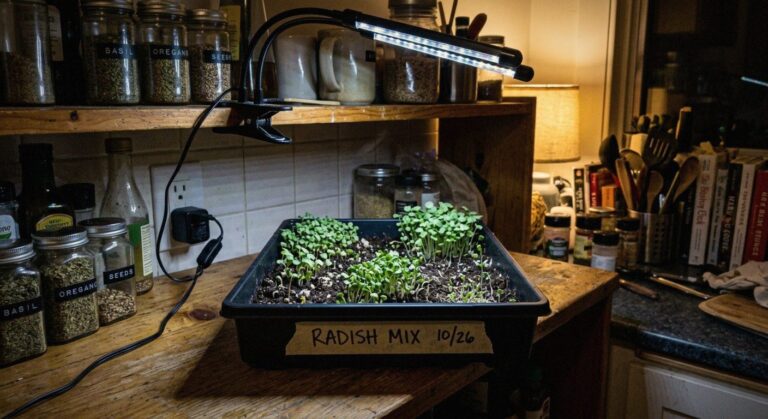
The GooingTop 6000K full-spectrum clip-on is the light we already recommend for herbs, and it’s the right starting point if your “indoor garden” is three or four 6-inch pots of loose-leaf lettuce on a kitchen counter, a single tray of microgreens, or scallions regrowing in a jar. It clamps onto a shelf edge or table, the gooseneck arms bend to sit right over the pots, and it has a built-in timer, so it switches itself on and off without you remembering.
What to know: coverage is the limit. Kept 6–10 inches above the leaves it lights a row of a few small pots or one tray well; it won’t light a whole shelf, and if you try, the plants at the ends will lean toward the middle. Buy it for a small setup and it’s excellent. Buy it for a big one and you’ll be back for something bigger by January.
2. SANSI 36W LED Grow Light Bulb — Best Single-Bulb Option
If you already own a clamp lamp or a desk lamp with a standard screw-in socket, the SANSI 36W full-spectrum grow bulb is the cheapest way to get real vegetable-grade light onto one spot. It’s a normal E26 bulb in 4000K white, so it looks like an ordinary lamp in the room rather than a science project, and the built-in lens focuses the light downward instead of spilling it across the ceiling. It’s rated for 25,000 hours, which at 14 hours a day is several winters.
What to know: that focused beam is a feature and a limitation. About 12 inches above the plants it lights one 10–12-inch pot of lettuce or a single 10×20-inch microgreens tray properly; it does not light a row. It also has no timer, so pair it with the outlet timer below, and use a fixture rated for at least a 40W bulb.
3. Barrina T5 2ft LED Grow Light Strips (4-Pack) — Best for a Shelf of Greens
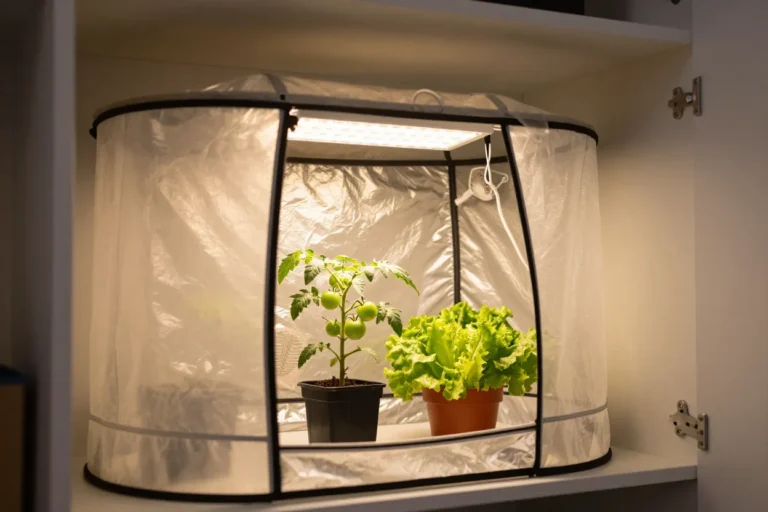
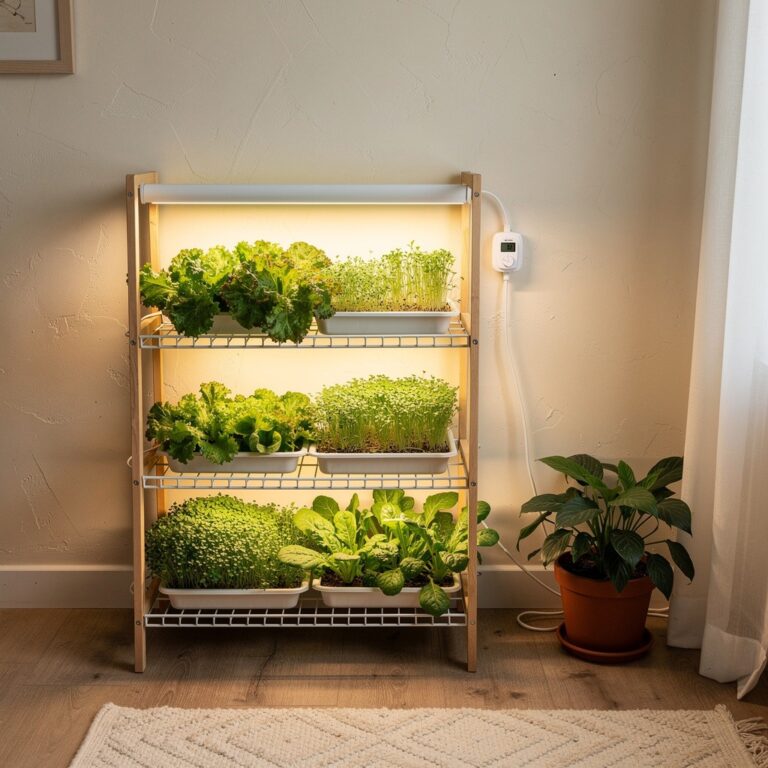
This is our overall pick, and the setup most indoor vegetable growers end up with sooner or later: slim LED strips mounted under a shelf, with trays of lettuce, spinach, and microgreens on the shelf below. The Barrina T5 2ft 5000K strips come four to a pack, link together end-to-end or run side by side, and plug straight into the wall with an on/off switch on the cord. The 5000K white looks like a bright kitchen light, not a purple glow, and the black housing disappears under a shelf.
Four strips spaced a few inches apart cover a 2-foot-wide shelf 12–16 inches deep evenly — enough for a full 10×20 tray, or two rows of pots — with none of the dim edges a single clip-on leaves. They mount under a bookshelf, a wire rack, or a cabinet with small clips or zip ties, so nothing gets drilled into a rental wall. And when you inevitably want a second lit shelf, another pack is the cheapest way to add one.
What to know: no built-in timer — add the outlet timer, which is a two-minute job. And these want to sit close: 6–12 inches above the leaves. Mounted under a tall shelf with the plants a foot and a half below, they’ll underdeliver.
4. Mars Hydro TS600 — Best for a Small Table or Corner
The Mars Hydro TS600 is a proper 100W panel — the kind of light designed for a small grow tent — and it’s the one pick here with enough output for more than leafy greens. Hung over a 2×2-foot table or corner it covers that whole area for greens, and it’s the only light on this list we’d trust for a compact fruiting crop over winter: a dwarf tomato, a couple of small peppers, or bush beans. It’s dimmable, so you can turn it down for seedlings and up as plants grow, and it’s fanless, which means silent — no hum in the room.
What to know: it needs to hang. You’ll want a hook, a shelf bracket, or a small frame to suspend it 18–24 inches above the plants, so it suits a dedicated table or corner rather than a kitchen counter. It’s bright — not something to run in a bedroom. It has no timer, and for a single tray of lettuce it’s more light than you need. For a small table of mixed vegetables through winter, though, it’s the light that makes the difference between “keeping plants alive” and actually harvesting.
5. Barrina CX3 4-Tier Plant Stand with Grow Lights — Best All-in-One
If you’d rather buy one thing and be done, the Barrina CX3 plant stand is a metal shelving unit with three 3-foot 5000K light bars already mounted (108W total), a mechanical timer built into the setup, and wheels. It’s about 35 inches wide, 14 deep, and 71 tall — a bookshelf-sized footprint that fits beside a window or in a spare corner — and nothing screws into a wall, which makes it the renter’s version of a real indoor garden.
Three of the four shelves sit under a light bar; use the unlit one for supplies or for plants that need less. A typical winter layout: seed trays and microgreens on one lit shelf, loose-leaf lettuce and spinach on another, herbs on the third. The wheels matter more than they sound — being able to roll the whole garden away from a cold window at night, or out of the way for guests, is the sort of thing that keeps a setup going past February.
What to know: it’s the most expensive option here and the most committed. If you’re not sure you’ll keep growing indoors past this winter, start with the T5 strips on a shelf you already own — they’re the same type of light, and you can always add the stand later.
Which Light Fits Your Space
| Light | Best for | Lights about | Timer built in? |
|---|---|---|---|
| GooingTop clip-on | 2–4 pots on a counter or windowsill | One tray or a short row of small pots | Yes |
| SANSI 36W bulb | One big pot, in a lamp you already own | One 10–12-inch pot or one tray | No — add an outlet timer |
| Barrina T5 2ft 4-pack | A shelf of lettuce, greens, and microgreens | A 2-foot shelf, 12–16 inches deep | No — add an outlet timer |
| Mars Hydro TS600 | A small table or corner; compact fruiting crops | A 2×2-foot area | No — add an outlet timer |
| Barrina CX3 stand | A dedicated indoor garden, no drilling | Three 3-foot shelves | Yes |
If you’re between two sizes, go smaller. A light that’s slightly too small for your ambitions still grows a good crop of greens; a light that’s too big for your space ends up unplugged because it’s too bright for the room.
Setting It Up: Distance, Hours, and the Timer
- Distance: clip-on and T5 strips, 6–12 inches above the leaves; the SANSI bulb, about 12 inches; the TS600 panel, 18–24 inches (closer, dimmed, for seedlings). If leaves look pale and stems stretch, lower the light. If the leaves nearest the light curl, bleach, or get crispy edges, raise it.
- Hours: 14–16 hours a day for lettuce, spinach, and other greens; about 16 for microgreens and pea shoots; 16 for anything fruiting. Leave at least 6–8 hours of dark. Run the light during the day so it adds to whatever window light there is.
- Timer: three of the five lights above have no timer, and this is the accessory that decides whether your greens get 14 hours a day or whatever you remembered to give them. A BN-LINK 24-hour mechanical outlet timer — the kind with pins you push down for the “on” hours — costs less than a bag of potting mix, plugs in between the wall and the light, and never needs reprogramming. Set it once in October and forget it.
- Running cost: less than people fear. A 40W shelf of T5 strips running 14 hours a day uses around 17 kWh a month — a few dollars at typical US electricity rates. The 100W panel is roughly two and a half times that. LEDs also run cool enough that none of these will heat the room.
- Bounce the light back: a white wall behind a shelf, or a sheet of white card or foil-lined cardboard around the sides, noticeably brightens the edges of a tray at zero cost.
- Water more often once the light goes on. Plants under a grow light grow faster and dry out faster than plants coasting through a dim winter. Check the soil every day or two for the first couple of weeks until you learn the new rhythm.
Best Grow Lights for Leafy Greens (and What Else Grows Under Each)
- Under any of the five: microgreens, loose-leaf lettuce, spinach, arugula, pea shoots, scallions, and herbs. These are the crops that make indoor winter growing worth doing — fast, harvested young, and forgiving of a small light. Our indoor winter vegetable gardening guide walks through each one.
- Under the T5 shelf or the CX3 stand: all of the above, in quantity — several trays at once, cut-and-come-again lettuce on rotation, baby kale and chard — plus starting your spring seedlings in February and March, which is where a lit shelf pays for itself a second time.
- Under the TS600 only: compact fruiting crops — a dwarf or “micro” tomato, small peppers, bush beans. These still want 16 hours of light, warmth, and patience; treat them as a winter project rather than a grocery replacement.
- Not worth it under any small light: full-size tomatoes, cucumbers, squash, corn, and root crops beyond a pot of radishes. They need more light, space, and time than an apartment setup can give them in winter. Wait for the balcony.
Common Mistakes
- Buying for the garden you might have someday. A 100W panel over one tray of lettuce is money and electricity spent lighting an empty table. Match the light to what you’re growing this winter.
- Expecting one clip-on to light a whole shelf. The opposite mistake, and just as common. If the plants at the ends lean toward the middle, the light’s footprint is too small.
- Skipping the timer. Inconsistent hours are the number one reason indoor greens grow slowly. Buy the timer with the light, not after.
- Mounting it too high. Small LEDs only work up close. A strip 2 feet above a tray of lettuce does almost nothing.
- Judging brightness by eye. Your eyes adjust; plants don’t. A light that looks plenty bright to you in a dim room can still be too weak for lettuce. Trust the plants — pale, stretched growth means more light, not more fertilizer.
- Forgetting to water more. The most common cause of a wilting tray in the first week under a new light is simply that it dried out faster than it used to.
Frequently Asked Questions
How many hours a day should a grow light be on for vegetables?
For lettuce, spinach and other leafy greens, 14–16 hours a day. Microgreens and baby greens do well with about 16. Always give plants a dark period at night; running a light 24 hours a day does not speed anything up. A plug-in outlet timer makes this automatic.
How far should a grow light be from lettuce?
Small LED strips and clip-on lights work best 6–12 inches above the leaves. A screw-in grow bulb works at about 12 inches, and a 100W panel like the TS600 at 18–24 inches. If plants look pale and stretched, lower the light; if the top leaves bleach or crisp, raise it.
Are purple (red and blue) grow lights better than white ones?
Not for a home setup. Full-spectrum white LEDs grow leafy greens and seedlings well, and they let you see whether the plants are healthy. Purple light makes it hard to spot yellowing or pests and is unpleasant in a living space.
Can I grow vegetables indoors with just a window in winter?
A few herbs can get by on a bright south-facing window, but a tray of lettuce or spinach usually cannot. Winter days are short and window light is weak, so indoor greens grow pale and leggy without a grow light.
How much does it cost to run a grow light?
Less than most people expect. A 40W shelf of LED strips running 14 hours a day uses about 17 kWh a month, which is a few dollars at typical US electricity rates. A 100W panel uses about two and a half times that.
Sources we checked
- Purdue Extension: Supplemental Light for Lettuce During Winter Production (HO-283-W)
- University of Illinois Extension: Grow Herbs and Lettuce Indoors This Winter
- University of Maryland Extension: Growing Microgreens and Baby Greens Indoors
- University of Minnesota Extension: Lighting for Indoor Plants and Starting Seeds
Once the light’s sorted, the rest is choosing what to grow. Our microgreens without sunlight guide is the fastest first crop under any of these lights, and how many lettuce plants per container covers spacing so a lit tray doesn’t end up crowded. If you’re still harvesting outside, spinach on a balcony in fall bridges the gap until the light goes on, and our Fall Container Garden Guide maps out the whole cold-season transition. New to growing food in a small space altogether? Start Here. And everything we actually use, including the clip-on light above, is on our Recommended Gear page.
Good light solves a lot, but not everything — if your indoor vegetables still look off, see our symptom-by-symptom troubleshooting guide for the other common causes.