Companion Planting for Container Vegetables: What Actually Works in a Pot
Companion planting charts make it look easy: tomatoes love basil, carrots love chives, marigolds keep every bug away. But those charts were written for garden beds, and a pot is a very different place. In a container, every extra plant is sharing the same few gallons of soil, the same water, and the same fertilizer. This guide separates the companion planting ideas that hold up from the folklore, then gives you sized pairings that work on a balcony and a short list of combos to skip.
This post contains affiliate links, meaning we may earn a small commission at no extra cost to you — full details are on our Affiliate Disclosure page.
Quick Answer
Companion planting in containers works best in two ways: a big pot with one main crop and one or two small, shallow-rooted partners at the edge (like a tomato with basil in a 10-gallon container), or separate pots grouped side by side so flowers and herbs can draw in pollinators and pest-eating insects without stealing root space. Most “X repels Y” claims have little research behind them. When in doubt, one plant per pot is the safer default.
What the Research Actually Supports (and What It Doesn’t)
Let’s start with the honest part. Linda Chalker-Scott, a horticulturist with Washington State University Extension, wrote a whole paper called “The Myth of Companion Plantings.” She compares traditional companion charts to horoscopes: fun to use, but not scientifically valid. She doesn’t say mixing plants is pointless, though. Her point is that the real benefits come from specific, testable mechanisms, not from plants that “like” each other.
Research-backed: flowers that feed beneficial insects
This is the best-supported reason to grow companions. University of Delaware Cooperative Extension explains that flowers provide nectar and pollen for hover flies (syrphid flies), lacewings, lady beetles, and tiny parasitoids (mostly small wasps). Hover fly larvae are hungry aphid eaters, and lacewings and lady beetles help control aphids too. The same flowers also bring in pollinators. Delaware singles out sweet alyssum because it’s cheap, easy, low-growing, and compact, “so it doesn’t compete with the vegetables.”
One honest caveat from the same fact sheet: more beneficial insects nearby doesn’t always mean fewer pests on your crop, because predators don’t always go where you need them. Think of flowers as helping the odds, not as a guarantee.
Research-backed: trap crops
A trap crop is a plant that pests like more than your main crop, so they gather there instead. University of Minnesota Extension notes that arugula, mustard, and napa cabbage can pull flea beetles away from other brassicas, and that mixes of three or more trap species work better than a single one. On a balcony, that can be as simple as a separate pot of mustard greens next to your kale.
Research-backed: interplanting fast crops with slow ones
Minnesota Extension also describes tucking early crops like lettuce, spinach, or basil in with later crops like tomatoes and peppers. By the time you harvest the quick crop, the slow crop’s leaves are filling in the space. UC Master Gardeners (UC ANR) describe the same idea: radishes and lettuce can be harvested before slower companions reach full size. This is about timing and space, and it works well in wide containers.
Research-backed: shade and living mulch
Taller plants can shade the soil and cool the microclimate for smaller ones. Chalker-Scott describes “nurse plants” that shade and shelter newly sprouted seedlings in much the same way. In a pot, a tomato’s canopy can give lettuce at its base some afternoon relief in early summer. The catch: shade only helps plants that want it.
Mostly folklore: “X repels Y”
This is where most charts go wrong. UC Master Gardeners say plainly that “many claims lack scientific proof they are effective.” Minnesota Extension notes that multiple studies have shown marigolds do not deter Colorado potato beetles, and that there’s little research to support marigolds repelling flea beetles from cabbage-family crops (though one study it cites found marigold, onion and nasturtium helped reduce cabbage worms). Claims like “basil makes tomatoes taste better” or “chives keep carrot flies away” come from tradition, not controlled trials. Plant these pairs if you like them, but don’t count on them as pest control.
Marigolds and nematodes are a good example of a real effect that gets stretched. University of Hawaii CTAHR research shows certain marigold varieties can suppress root-knot nematodes, but they’re typically grown as a dense cover crop for two to four months, and only living roots do the work. A single marigold in a pot won’t do that. And if you’re using fresh bagged potting mix, soil nematodes usually aren’t a problem you need to solve in the first place.
Why Containers Change the Rules
In the ground, roots can spread out and chase water and nutrients far past a plant’s leaves. In a pot, they can’t. Two plants in one container are competing for:
- Root space. A tomato can fill a 5-gallon bucket with roots on its own. Add a pepper and neither one gets enough.
- Water. More leaves means the pot dries out faster. On a hot day, a crowded container can go from moist to wilting between morning and evening.
- Nutrients. Potting mix holds a limited supply, and frequent watering washes nutrients out. Two heavy feeders run it down twice as fast.
- Air. University of Maryland Extension warns that planting too densely raises the risk of leaf diseases because air can’t move around the foliage.
That’s why “One Plant, One Pot, One Harvest” is our default advice for beginners. It’s not that companions never work in pots. It’s that they only work when the pot is big enough and the partner is small enough. Our guide to pot size and drainage covers the baseline sizes for single plants; companions need you to size up from there.
The Two Ways Companions Work on a Balcony
1. Big pot, small partner
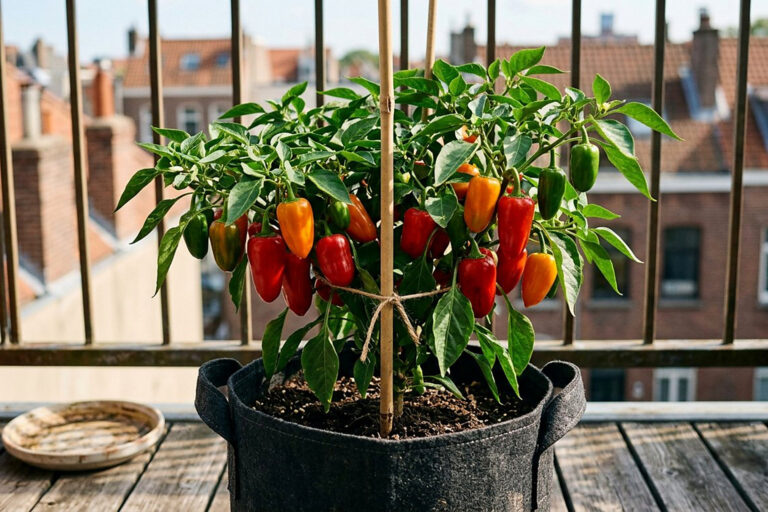
Put one main crop in the center of a large container and add one or two small, shallow-rooted plants near the rim. The partner should be something you’ll harvest early or keep trimmed, so it never grows into a real competitor. A 10-gallon container is the practical minimum for a tomato plus a partner. Fabric bags like these Gardzen 10-gallon fabric grow bags work well here: they’re wide enough to leave a ring of open soil around the main plant, and the fabric lets extra water drain freely.
2. Neighboring pots
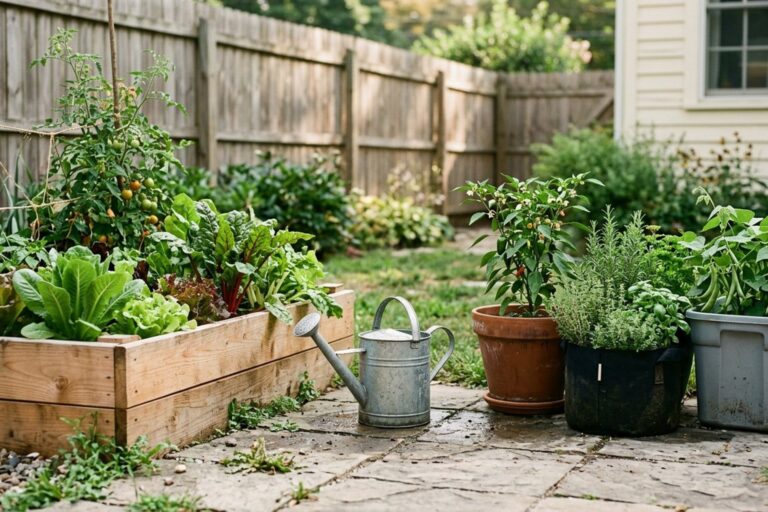
This is the underrated option. Pollinators and beneficial insects don’t care whether the alyssum is in your pepper’s pot or 12 inches away. Grouping pots gets you the insect benefits with zero root competition, and each plant gets watered and fed on its own terms. For most balconies, this is the smarter approach.
Container Companion Combos That Actually Work
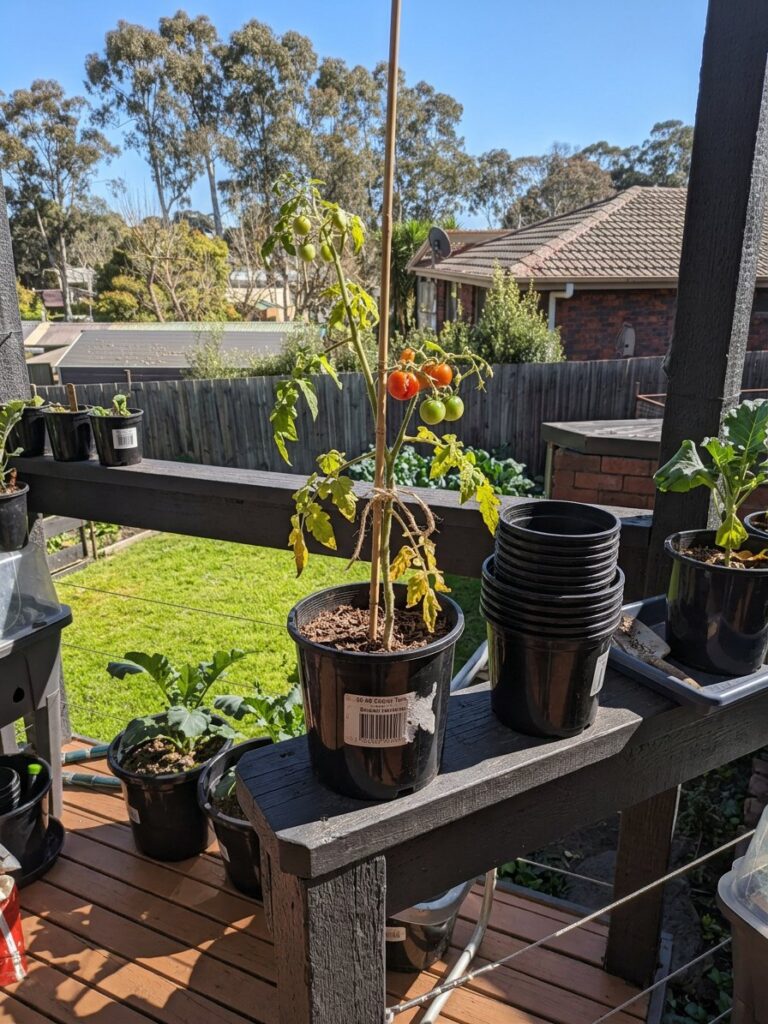
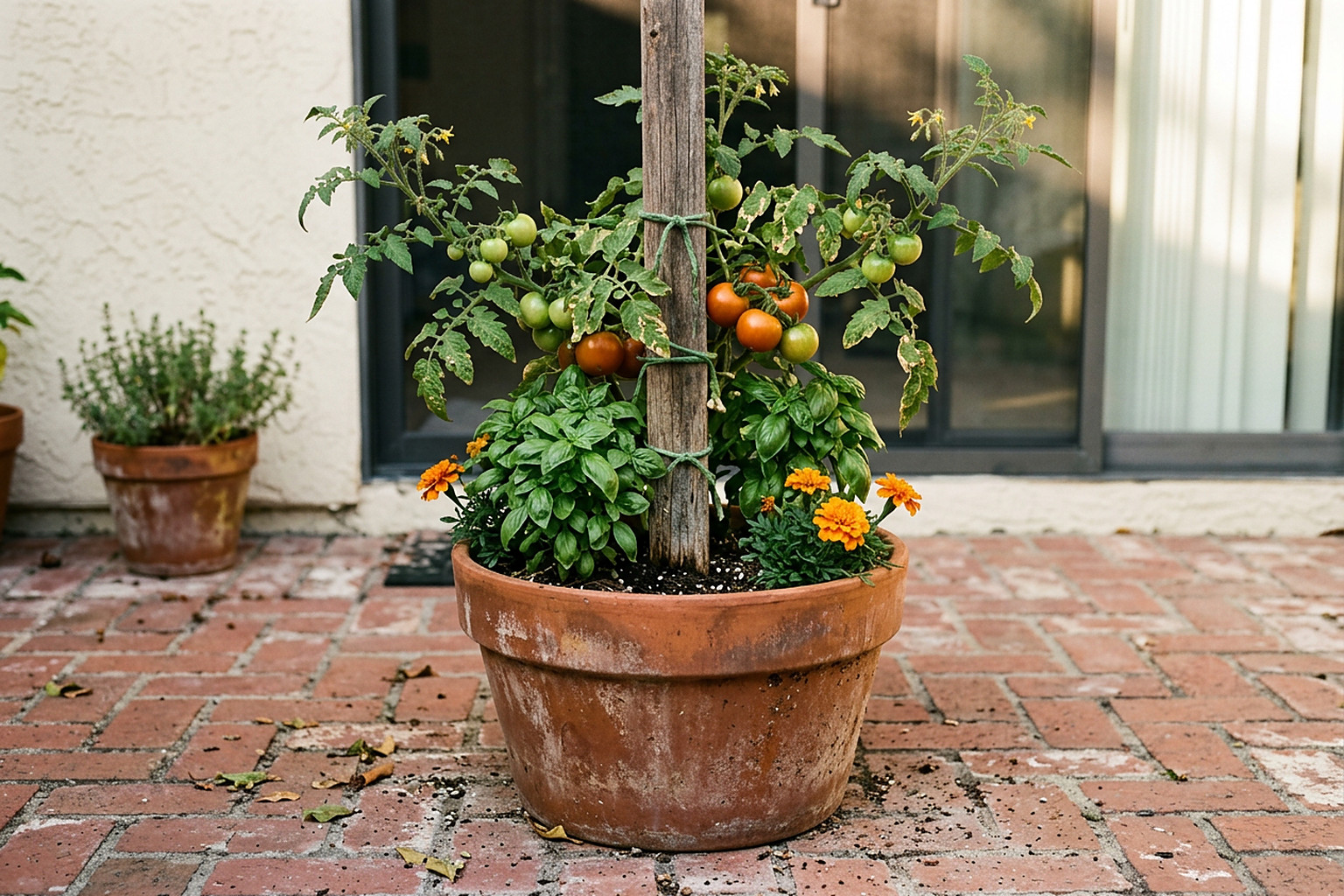
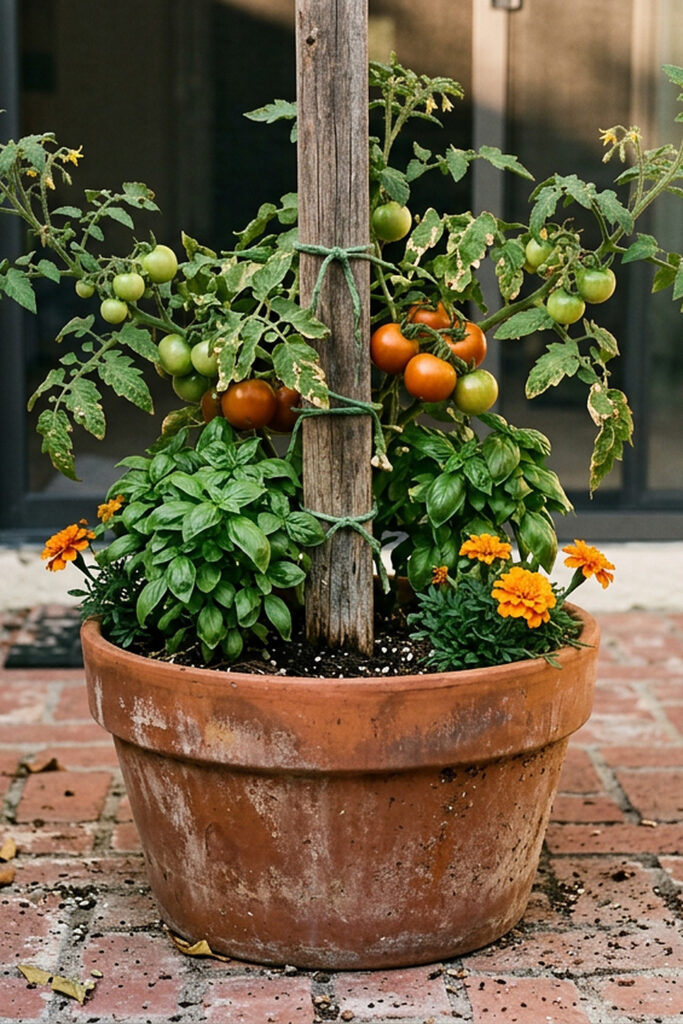
Tomato + basil in a 10-gallon container
Plant one tomato in the center and one or two basil plants 3 to 4 inches in from the rim. Basil’s roots are fairly shallow and it stays small if you pinch it regularly, which you’ll want to do anyway for cooking. Both need 6 to 8 hours of sun and warm nights above about 50°F, so their needs line up well.
- Best tomato type: a compact determinate or patio variety. A big indeterminate will crowd the basil out by midsummer.
- Why it works: shared sun and heat needs, a small partner, and basil flowers (if you let a stem or two bloom) attract pollinators.
- Why it’s not magic: there’s no solid evidence that basil repels tomato pests or improves flavor.
- Don’t try it in a 5-gallon bucket. Keep the tomato alone there, as in our 5-gallon bucket tomato guide, and grow basil in its own 1- to 2-gallon pot beside it.
Variation: in spring, plant 2 or 3 leaf lettuce plants around the edge of the same 10-gallon container when you set out the tomato. Pick them as baby greens over the first 4 to 6 weeks. By the time the tomato fills in, the lettuce is done. This is the fast-crop/slow-crop interplanting Minnesota Extension describes.
Pepper + marigold or alyssum as neighboring pots
Keep your pepper in its own 5-gallon pot and set a 1-gallon pot of sweet alyssum or French marigolds right next to it. The flowers bring in hover flies, lady beetles, and pollinators, and pepper flowers self-pollinate but still benefit from a little insect traffic. Peppers want 6 to 8 hours of sun and warm soil, and they don’t like being crowded, so the separate pot keeps them happy.
Lettuce + radishes (or scallions) in a wide trough
A window box or trough about 24 to 30 inches long and at least 6 to 8 inches deep works; 12 inches deep gives you more room for error with watering. Sow radishes in a row down the middle and set lettuce plants along both sides.
- Radishes are ready in about 25 to 30 days and pull out cleanly, opening space just as the lettuce starts to spread.
- Leaf lettuce is ready to pick in about 30 to 45 days. Space plants about 6 inches apart for cut-and-come-again harvests (see how many lettuce plants per container for exact numbers).
- Scallions can replace the radishes. They’re slim and upright, so they barely shade the lettuce.
- All three tolerate cool weather and light frost, so this combo suits spring and fall. Lettuce and radishes do fine with 4 to 6 hours of sun.
Carrots + chives in a deep pot
Carrots send one narrow root straight down; chives form a shallow clump. That different rooting depth is why they can share a pot. Use a container at least 12 inches deep (and wider than it is tall if you can). Sow carrots across the middle and plant one small chive clump at the edge. Short varieties like ‘Paris Market’ or ‘Danvers Half Long’ are the easiest in pots, and most carrots take 60 to 75 days.
The claim that chives keep carrot rust flies away is anecdotal. The reliable benefits: chives don’t compete much, and their purple spring flowers draw pollinators and beneficial insects.
Kale + a trap-crop pot of mustard or arugula
Flea beetles chew tiny holes in cabbage-family greens. A separate pot of mustard greens or arugula next to your kale can draw them away. Sacrifice the trap pot; that’s its job.
If you add only one companion to your balcony, make it sweet alyssum. It stays about 4 to 6 inches tall, blooms for months, and its shallow roots can even share the edge of a large vegetable pot. For herb pairings that share a window box, see our companion herbs window box guide.
What Not to Crowd Together
These warnings are based on things you can actually see happen in a pot: competition, clashing needs, and aggressive growth.
- Mint with anything. University of Maryland Extension describes mint as spreading aggressively and suggests giving it its own container about 12 to 16 inches across. In a shared pot, its runners will take over the root space.
- Fennel in a mixed pot. UC Master Gardeners list fennel (along with sunflowers) as allelopathic, meaning it can release compounds that harm nearby plants. It also gets big. Give it its own pot or skip it.
- Two heavy feeders in one container. Tomato + pepper, tomato + squash, or tomato + cucumber in one pot means double the thirst and hunger with the same soil. UC Master Gardeners also warn against pairing heavy feeders. Give each its own 5-gallon (or larger) pot.
- A tall plant shading a sun lover. A tomato canopy can help lettuce in early summer, but it will stunt basil or peppers planted on its shady side. Put the partner on the sunny side of the pot.
- Plants with opposite water needs. Rosemary and thyme like to dry out between waterings; lettuce and tomatoes don’t. Mixing them means one of them is always unhappy.
- Too many “just one more” plants. Maryland Extension notes that dense planting raises disease risk and lowers productivity. If a pot looks full the day you plant it, it will be overcrowded in a month.
Quick-Reference Table
| Pairing | Setup | Minimum size | Real benefit | Evidence |
|---|---|---|---|---|
| Tomato + basil | Same pot, basil at edge | 10 gallons | Shared needs, pollinators if basil blooms | Pest claims are folklore |
| Tomato + leaf lettuce | Same pot, lettuce picked early | 10 gallons | Fast/slow interplanting | Supported |
| Pepper + marigold or alyssum | Neighboring pots | 5 gal pepper + 1 gal flowers | Beneficial insects, pollinators | Supported (flowers); nematode claim needs a dense cover crop |
| Lettuce + radish or scallions | Same trough, radish row in middle | 24–30″ long, 6–12″ deep | Fast/slow interplanting | Supported |
| Carrots + chives | Same pot, chives at edge | 12″ deep | Different root depths, chive flowers for insects | Carrot fly claim is anecdotal |
| Kale + mustard/arugula | Neighboring pots | 2–3 gal each | Trap crop for flea beetles | Supported |
| Any crop + sweet alyssum | Pot edge or neighboring pot | Small pot is fine | Beneficial insects | Supported |
| Mint + anything | Avoid in shared pots | Own pot, 12–16″ wide | — | Spreads aggressively |
| Fennel + anything | Avoid in shared pots | Own 5+ gal pot | — | Allelopathic |
Care Tips for Shared Containers
- Check water daily in summer. A shared pot has more leaves pulling water. Push a finger 1 to 2 inches into the soil and water when it’s dry at that depth, until water runs out the bottom. Our container watering guide has a full schedule.
- Feed a little more. Use a quality potting mix and a balanced fertilizer on schedule; Maryland Extension suggests light feeding about every two weeks for long-season crops like tomatoes. See soil and fertilizer basics.
- Harvest the partner on time. A partner left to grow unchecked becomes a competitor. If roots are tangled, snip it at soil level instead of yanking.
FAQ
Can I plant a tomato and a pepper in the same pot?
It’s possible in a very large container (15 gallons or more), but it’s not a good beginner move. Both are heavy feeders with big root systems, so they compete hard for water and nutrients. Two 5-gallon pots side by side will almost always out-produce one crowded pot.
Do marigolds keep bugs off my vegetables?
Not reliably. Studies haven’t supported the idea that a few marigolds repel pests from nearby plants. Grow them because they bring in helpful insects and look cheerful, not as a pest shield.
Does basil make tomatoes taste better?
There’s no good evidence for that. Flavor comes mostly from the tomato variety, sunlight, and consistent watering. They’re still a practical pair because they want the same sun and warmth.
What’s the smallest pot that can hold a companion pair?
For a tomato or other large crop plus a partner, 10 gallons is the practical minimum. For small crops like lettuce and radishes, a trough 6 to 12 inches deep and about 2 feet long works. Anything smaller, and you’re better off with separate pots grouped together.
Your Next Step
Start simple: put your main vegetable in its own pot, set a small pot of sweet alyssum or basil beside it, and watch who shows up. That one move gets you most of the real benefit of companion planting with none of the crowding. If you’re still picking your main crop, our list of the best vegetables for pots is the place to begin.