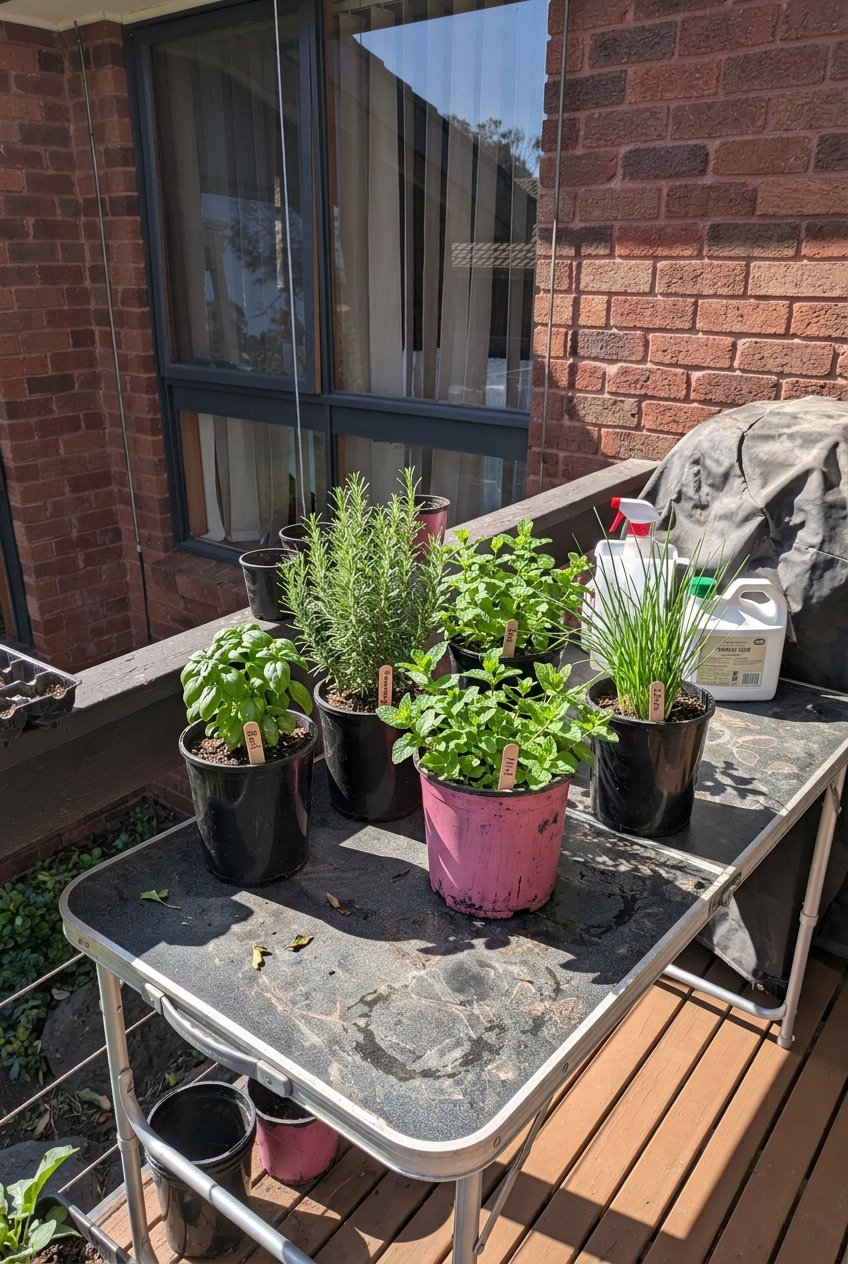
Best Grow Lights for Small-Space Herbs (What Actually Matters)
Somewhere around the end of September, a lot of windowsill herb gardens quietly stop growing. The basil that was bushy in August turns pale and leggy, the mint slows to a crawl, and nothing you do with water or fertilizer seems to fix it. It isn’t the care. It’s the light. Days get shorter, the sun sits lower, and a window that gave herbs 6 hours of direct light in summer might give them 2 or 3 by November. A small grow light is the one piece of gear that fixes this — and you need far less of it than most product listings suggest.
This post contains affiliate links, meaning we may earn a small commission at no extra cost to you — full details are on our Affiliate Disclosure page.
Do You Actually Need a Grow Light?
Not always. If you have a south- or west-facing window (in the Northern Hemisphere) that gets direct sun for 5 or more hours a day, most herbs will muddle through winter without help. They’ll grow slower, but they’ll grow. For reference, Iowa State University Extension says most herbs need around eight hours of direct light a day indoors, and Penn State Extension puts basil and rosemary among the herbs that need at least six. You probably do need one if any of these sound familiar:
- Your only windows face north or east, or they’re shaded by a building, balcony overhang, or tree.
- Your basil stretches toward the glass and its leaves get smaller and paler each week.
- You want to start herbs from seed indoors in fall or winter, not just keep existing plants alive.
- You’re growing on a kitchen counter or shelf rather than a windowsill at all.
The honest test: put your hand where the plants sit at midday. If it doesn’t cast a sharp shadow, the light there is too weak for basil, and probably too weak for rosemary too. Mint and parsley are more forgiving, but even they will sulk by December.
What Actually Matters in a Small-Space Grow Light
Grow light listings are full of numbers that don’t matter for a few pots of herbs. Here’s what does:
- Full-spectrum white LEDs. Skip the purple “blurple” red-and-blue panels. Modern full-spectrum white LEDs grow herbs just as well, look like a normal lamp in your kitchen, and let you see whether your plants are actually healthy.
- Size matched to your pots, not your ambitions. Three or four 6-inch pots need a clip-on or a short bar light, not a 100-watt panel. Oversized lights waste power and, mounted too close, can scorch tender basil.
- A built-in timer. This is the feature that makes or breaks it. Herbs want 12–14 hours of light a day in winter, consistently. A timer means the light runs itself; without one, you’ll forget within a week.
- Adjustable positioning. A flexible gooseneck or an adjustable hanging height lets you keep the light 6–12 inches above the leaves and raise it as plants grow.
- Dimming or brightness levels. Nice to have, not essential. Useful if the light is in a room you spend evenings in.
What you can mostly ignore: wattage claims (marketing numbers are rarely the real draw), color temperature debates (anything from roughly 4000K to 6500K white works for leafy herbs; University of Minnesota Extension notes that white or balanced bulbs suit most plants at any stage), and anything described as “commercial” or “for tents.”
The Three Types Worth Considering
Clip-on gooseneck lights (best for 1–4 pots)
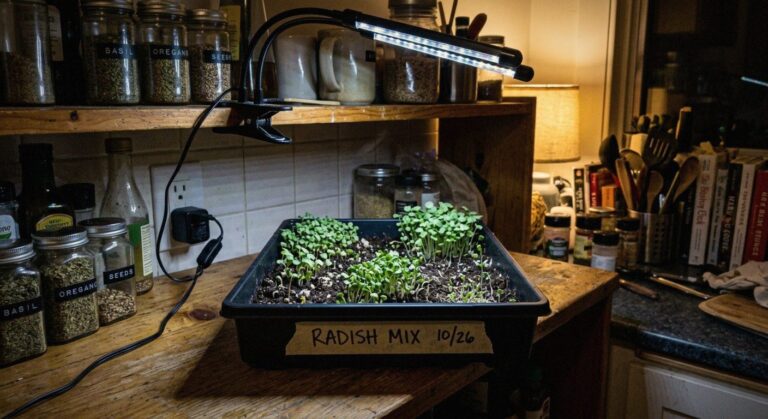
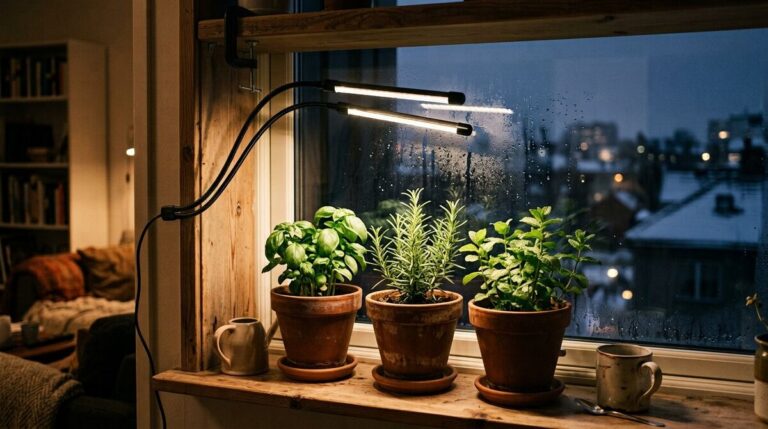
These clamp onto a shelf edge, windowsill, or table and have one to three flexible arms you aim at the pots. They’re the cheapest option, take no permanent installation, and are what almost every apartment herb grower should start with. Our pick is the GooingTop 6000K Full Spectrum clip-on grow light — full-spectrum white LEDs, a gooseneck that reaches over a row of pots, and a built-in timer so it switches itself on and off. It’s the light we recommend on our Recommended Gear page for exactly this job.
Bar or strip lights (best for a windowbox or a shelf)
A slim LED bar mounted under a shelf or hung above a long windowbox covers a row of plants evenly, where a clip-on would leave the ends dim. They usually need screws, adhesive strips, or a hanging kit, so they suit renters less well unless you mount them to a freestanding shelf. Look for one with a plug-in timer if it doesn’t have its own.
Grow bulbs in an ordinary lamp (best for a single pot)
A full-spectrum LED bulb screwed into a desk lamp or clamp lamp you already own is the lowest-cost route for one rosemary plant or a single pot of basil. The limitation is coverage — one bulb lights one pot well — and you’ll need a separate outlet timer.
How to Use It: Distance, Hours, and Placement
- Distance: start with the light 6–12 inches above the leaves, the range Iowa State Extension recommends for herbs. If leaves look pale or stems stretch, lower it. If the leaves closest to the light curl, bleach, or get crispy edges, raise it.
- Hours: 12–16 hours a day. Iowa State Extension recommends 12 to 16 hours for herbs under lights, and Penn State’s guidance says 14 to 16. Aim for the top of that range for basil and rosemary, the two herbs that want the most light. Give every plant a dark period overnight — 24-hour light doesn’t speed things up.
- Timing: run the light during the day so it supplements whatever window light there is, rather than replacing it at night.
- Placement: a grow light doesn’t need to be at a window at all. A kitchen counter, a bookshelf, or a corner table works, which frees up the windowsill for plants that don’t need help.
- Rotate the pots a quarter turn every few days if the light comes from one side, so plants grow evenly instead of leaning.
Grow Lights for Rosemary
Rosemary gets its own section because it’s the herb people most often lose indoors over winter. Iowa State Extension lists it among the herbs with higher-than-normal light needs indoors, and it’s prone to spider mites. What works:
- Put it closest to the light. Keep the light about 6 inches above the top of the plant (the near end of Iowa State’s 6–12 inch range) and run it 14–16 hours a day.
- Keep it cool. Illinois Extension says rosemary prefers a cool, even cold, sunny spot, and Penn State notes it can handle the mid-to-low 40s°F. A bright, cool room suits it better than a warm kitchen counter.
- Water sparingly. Let the mix dry slightly between waterings. Illinois Extension warns that brown tips and dieback indoors are usually caused by dry air, not by too little water, and suggests a saucer of wet pebbles under the pot for humidity.
- Expect slow growth. Rosemary barely grows on short winter days. Under a light the goal is to keep it healthy until spring, so harvest lightly.
- Check for spider mites. Look under the needles for fine webbing or pale speckling every week or so, especially in dry, heated rooms.
Which Herbs Benefit Most
Basil is the herb that most needs a light and most rewards one — it’s the difference between a leggy stem with four leaves and a plant you can actually harvest from in January. Cilantro and dill are close behind. Mint, parsley, and chives tolerate lower light but grow noticeably faster under a lamp. Rosemary, thyme, oregano, and sage come from sunny Mediterranean hillsides and want bright light, but they grow slowly in winter regardless, so a light mostly keeps them healthy rather than productive. For a full care rundown on the three herbs most people start with, see our guide to basil, rosemary, and mint windowsill care.
Common Mistakes
- Mounting it too far away. A light 3 feet above the pots does almost nothing. Small LEDs only work up close.
- Running it 24 hours. Plants need a dark cycle. It also wastes electricity and bleaches leaves.
- Buying for the plants you might grow someday. Start with a clip-on. Upgrade only if you outgrow it.
- Leaving basil on a cold window. Penn State Extension notes basil can’t survive temperatures below 50°F and advises keeping it off windowsills in winter. Give it a grow light somewhere warmer instead.
- Adding light but not adjusting water. Plants under a light grow faster and dry out faster than plants coasting through a dim winter. Check the soil more often once the lamp goes on.
Frequently Asked Questions
How many hours a day should a grow light be on for herbs?
12 to 16 hours. That is Iowa State Extension’s range for herbs under lights, and Penn State suggests 14 to 16. Use a timer so it runs the same hours every day, and turn it off overnight.
How far should a grow light be from herbs?
Iowa State Extension recommends 6 to 12 inches from the leaves. Use the closer end for basil and rosemary. If the leaves nearest the light bleach, curl or get crispy edges, raise it a little.
Can rosemary survive indoors all winter under a grow light?
Yes, if it gets strong light, a cool room and not too much water. Illinois Extension says rosemary prefers a cool sunny spot and soil kept on the dry side. Expect very little new growth until spring, and check for spider mites.
Which herbs grow best indoors under lights?
Iowa State Extension names parsley, mint, chives, basil, oregano, cilantro and thyme as herbs that adapt well indoors. Rosemary is harder because it needs more light and attracts spider mites.
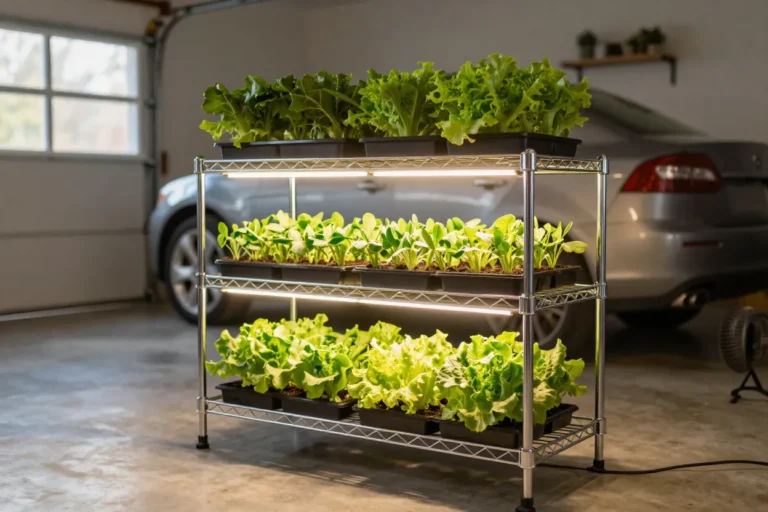
If you’re new to windowsill growing altogether, Start Here covers the basics before you plant anything. And if the light is sorted but your herbs still aren’t thriving, the problem is usually the pot or the soil — our pot size and drainage guide is the next place to look. And if frost is on the way, our guide to overwintering herbs before the first frost covers which herbs are worth bringing in under that light for winter. And if you’re lighting more than herbs — a shelf of greens or microgreens too — our grow lights for indoor vegetables roundup covers lights sized for that, and our indoor vegetable gardening guide covers the fuller setup beyond just the light.
Ready to grow more than herbs under that light? Our guide to grow tents for vegetables covers the step up to tomatoes and peppers.
Light isn’t the only thing that can go wrong with indoor herbs — if leaves are yellowing or growth has stalled, our symptom-by-symptom troubleshooting guide covers the other common causes.